I WANT TO CARE ABOUT THE CHARACTERS
Say, folks, have we ever talked about POV (point of view)? Ha ha, okay, so accuse me of beating a dead horse! I can’t help getting on the bandwagon (hey, two clichés in a row) with this. I recently finished reading another book by the author I love to hate.
Yup, I’m a glutton for punishment.
I won’t mention the author’s name, but I’ve railed on his work before. The funny thing is that two books ago, I read another one by a different author that did the same thing.
PSEUDO-OMNISCIENT
To me, besides present-tense, this is a growing plague taking over the publishing industry. While it’s predominantly in self-publishing, it’s creeping into mainstream conventional books more and more.
By pseudo-omniscient, the point of view, isn’t truly from the omniscient viewpoint because it isn’t “god” looking down and observing what the characters are doing. Instead, the author is employing third-person deep point of view for each character. They’re going deep, but also head-hopping willy-nilly, with no discernable choice of character.
What does that leave us with?
WEAK EMOTIONAL INVESTMENT
When the point of view shifts from paragraph to paragraph, even sentence to sentence, there’s nobody steering the ship!
There’s nobody steering the ship!
How do you decide who’s the main character?
Well, you can’t because it’s a cast of thousands. When the author is going deep POV for everybody that shows up in the scene, you have to figure who predominates the scene or chapter, probably by the sheer number of lines that character has.
In other words, the main character is the one with the most lines.
What the hell?
WHO CARES?
Despite what the back cover blurb says, “So and so goes here and does this, and must surmount these obstacles…bla bla bla…” this person is so buried in the text by other characters, good luck picking them out of the mess!
I’ll tell you what, I certainly don’t care about the characters, the twenty, thirty, a hundred characters who all get deep POV lines. All I want to know is what happens.
I can sort of enjoy the story if it moves and it’s good, but as far as the people in it, they’re just noise.
A BAD TREND
Call me old fashioned, call me stuck in my ways if you want to. I just want good quality work out there that people can follow, understand and get the most enjoyment out of.
When you can’t even keep track of the characters or develop an emotional investment in any of them because of the noise, it’s a bit schizophrenic to me. Why bother?
Please consider one character POV per scene or chapter. Be easy on your readers.
Happy writing!
WHEN THE BIG MCGUFFIN DOESN’T CUT IT
The inspiration for this article comes directly from a spy thriller I finished not long ago. I had a lot of fun reading this story. However, the author dangled the carrot, repeatedly, which was the entire premise of the book, for over three quarters of the story. The actual McGuffin, when revealed, was a huge disappointment, a cliché, more or less because it’s been done, guessed at, or what was expected so many times.
I was hoping for something a bit more original, more of a surprise. After all, the buildup was immense, with threats of immense proportions, something that would rock the world and all that. Yet, it didn’t rock me at all. Maybe I’m too jaded? In this day and age, I can’t be the only one.
I DON’T BELIVE IN DANGLING CARROTS
I, for one, don’t believe in dangling carrots. Though, of course, I don’t reveal the answer to the plot on page one, I also don’t dangle the most amazing and fantastic reveal to the reader throughout the story, either. I know that I can never live up to it. I don’t understand why authors like to do that when in this jaded society, it’s so hard to come up with something truly amazing and outlandish.
THE BIG MCGUFFIN
The big McGuffin is of course, the big surprise, the main plot twist at the end. The reason for the story, or the whole premise for the rest of the book. While there are many ways to go about it, giving the readers it’s something beyond their expectations is not the way to go about it.
The idea is to surprise the reader, sure, but not by blatantly telling them you’re going to surprise them. It should be done with a feather, not a sledgehammer.
You especially don’t want to build up expectations, only to disappoint the reader with something that’s mundane.
Let the story build up their expectations, take them in directions they didn’t expect, keep them guessing. Hopefully, they won’t be disappointed. There are no guarantees, of course.
Surprise, which is hard to do, is a goal, but disappointment isn’t going to help that, especially with a self-induced buildup to nothing.
SUGGESTIONS
I’ve always enjoyed stories the most, not when the big McGuffin is built up as something super-fantastic or super whatever, but when it’s subtly handled. I may have an idea what it is, so if it turns to be true, I’m not disappointed. On the other hand, if I guessed wrong, I’m more pleasantly surprised. When the author blatantly builds it up and then it’s revealed to be something mundane, I’m disappointed, even if the story was good.
Don’t do that! Keep a handle on it.
Or, don’t dangle the carrot at all and let the reader find out what’s going on along with the characters. Leave it all a mystery until near the end. Nobody can figure out what and why until then. That’s always a lot of fun!
DON’T DIG YOURSELF A HOLE
If you’re going to dangle the carrot, make sure your McGuffin is something worth dangling. If not, you’re going to disappoint a lot of people.
I’m just saying.
Happy writing!
CLEANING UP YOUR PROSE
As not only an editor but a self-editor (since I’m also a writer), I see everything under the sun when it comes to extra verbiage. We all do it. Whether it’s extraneous words in our narrative or dialogue to plain old excess narrative, we need to write lean, mean and get to the point. The more garbage you add on, even if some literary circles love words, most readers will lose interest (or at least struggle to stay interested). Also, those extra words add clutter that weakens the impact of everything you’re trying to say.
Self-editing has its hazards. There’s always the forest-through-the-trees mentality. That’s unavoidable because you’re too close to the story and your mind tends to fill in what you intended to say rather than what you put on the page. The way to fix a lot of that is to set the writing aside, move on to something else and come back to it later. The biggest fix is experience. The more you write and learn the craft, the cleaner you’ll write, as long as you heed advice, have the aptitude to pick up the tricks, and practice them. Also, when you go back for the second or third or more edits, you’ll more easily spot the issues and fix them.
WHAT IS EXTRA VERBIAGE?
Wow, where to begin?
REPEATED WORDS
How about double/repeated words? I don’t mean stuttering like bbbbut or he he he did this. I’m talking about using the same key word two or more times in the same sentence or within the same paragraph. In this case, I’m not talking about articles such as the and and, but for instance, unique words like a common action tag…nodded.
Nodded, used as a tag, is one of my weaknesses. Detach nodded…whatever…
In the next paragraph, or maybe the one after that, Elroy nodded…whatever…
Repeated words.
When you see multiple action tags using the same word on the same page, or even too often within the same chapter, the repetition becomes noticeable.
Using window five times in a paragraph.
Repeating a character’s name five times within a paragraph. It should only be there once. Then, when you fix it, if the name is at the start of each sentence, you replace it with He or She. Guess what? Now you have the character’s name once, but either he or she four times starting each sentence! Same problem, you just replaced one repeated word with another. Time to re-write three of those sentences to eliminate the need for the pronoun at the beginning of each sentence. Also, keep in mind using too many of them hidden within each sentence. See how you can eliminate some of them within each sentence by re-writing the sentences to avoid having to use the pronoun constantly. A lot of this comes to style and feel.
PRONOUNS
Speaking of which…with some authors, there isn’t a pronoun they don’t love.
This is especially true in first-person but can also have a huge effect in third.
In first-person, it’s I, me, my in every sentence. You have to get creative to eliminate them or it gets repetitious.
In third person, it’s he, she, him, her in excess. Same difference.
In true omniscient, it’s they & them.
ADVERBS
It’s said that some authors never found an adverb they didn’t like. I’ve read a few of these people.
Very, absolutely, considerably…the list goes on. These are all extra words that have little to no impact on the sentence.
Example: Joe stood back and stared at the very huge man.
Joe stood back and stared at the huge man.
While I have other issues with that sentence, the main one is the completely (also an adverb) unnecessary very in the sentence.
You can tell a lot of adverbs because they end in ly.
Another one is just.
Cyndi got there just in time.
In this case, you can almost justify using it.
I’d make it less passive.
Cyndi rushed through the door two seconds before the train pulled away.
COMMON CONVERSATIONAL & OTHER PHRASES
There are certain common phrases we use in dialogue and elsewhere that don’t belong in narrative.
Though it would seem Randy was hungry, he could not eat.
No ceegar, folks.
Despite his stomach pangs, Randy could not eat.
RESEARCH
The best way to learn these things is to practice practice practice. Also, if you haven’t had classes, belong to a writer’s group or have a mentor to help you, check out books in the library or on-line on grammar, adverbs & style. These books can do wonders. I have to admit I’ve never cracked one of those books because I learned from alternative methods.
Happy writing!
DEALING WITH WRITER’S BLOCK
Once again, I’ve been inspired by recent threads on a forum. Someone asked how to deal with writer’s block. This is something that occurs way too often, especially with writers that, at least to me, take this passion as a hobby. On the other hand, when one cannot fully grasp the concept of seat-of-the-pants writing, there’s the real possibility of writing into a trap. Maybe it’s time to try outlining. On the other hand, using some of these following techniques may also be a cure.
This article is almost a challenge for me because since I found this passion back in 1995, I’ve never had writer’s block. The ideas just keep flowing and the one time I did have writer’s block, back in 1972 when I tried my hand at that pathetic Star Trek satire, it deserved to be blocked!
WHAT IS WRITER’S BLOCK?
This may seem like a dumb question to those of you that have experienced it, but if you haven’t yet, it’s where you reach a point in your creativity where the well runs dry. You get to a point in your story, or maybe before you even start, and can’t think of a thing to say. Nothing. You sit down at the computer, or twiddle the pen or pencil in your hand and stare at the blank screen or paper and stare…and stare and nothing comes. You blink your eyes, twiddle some more, tap your fingers. A swell of unease rises from the pit of your stomach. This eventually blossoms into panic. Maybe a deadline looms, whether real or imagined. The panic turns into a mental block that becomes an outright wall of despair.
I can no longer write! Aaagh!
For those of you that have experienced writer’s block, is that about it? Is it close?
SOLUTIONS
Though I haven’t personally had the problem, when it comes to writing at least, I have had similar issues in other areas. Plus, I’ve paid attention to the threads and listened to others in conversation with potential ways to solve writer’s block.
JUST QUIT
One thing you can do is just quit. Think about it. One reason you may have writer’s block is that you’re all hung up on having it in the first place. You’re so worried about finishing your story, or about some roadblock to your creativity, why not just back off and quit for a while? I hate to cop that old Billy Bass phrase from the song by Bobby McFerrin, but how about a little Don’t worry, be happy? I’m dead serious. Go on to something else for a while. When the muse strikes you again, it might be something sneaky that creeps into your subconscious that tells you your solution, or it might be while you’re out driving, shopping, or wake up from a vivid dream and it hits you like a lightning bolt. Aha! The block is over!
WRITING EXERCISE
How about doing a writing exercise? Maybe try flash fiction. Take your mind off your present predicament and go into something else for a while. Write one or a couple of flash fiction pieces. Maybe even start an unrelated novel. What if something within those unrelated stories clicks and gets you back to your square one or two or three of your writer’s block?
BREAK IT DOWN
Try breaking down what happened. You have writer’s block but why? What caused the writer’s block? Did you run out of ideas? Did you write yourself into a corner? If you just finished a novel and are supposed to start another one in a series, what if there shouldn’t be another one? Say, you’re expected to make a third book in a trilogy, but you can’t come up with a good idea for book three? You never planned it well enough ahead? Uh oh? Or, say, you’d mapped it all out but for some reason, you accidentally combined book three’s plot in book two…or…that original idea became moot for book three? Now what? Writer’s block!
Now, you have to come up with something else. By analyzing it…not agonizing over it, maybe you can come up with something interesting. Here again, if you hit a wall, just stop and move on to something else. If you have a deadline, getting freaked out about it isn’t going to make matters any better. Stop. Let your mind go blank. Bandy thoughts as they come along. Don’t discard anything outright, but then again, look at each idea carefully. You don’t want to retread, or go into cliché but at the same time, you may have written yourself into something that’ll be hard to get out of.
CONSULT YOUR PEERS
It never hurts to ask your peers for advice. It’s not like they’re going to steal your ideas…well, unless you’re writing a screenplay! Geez, you have to be so careful showing screenplays around Hollywood! Sorry, I’m off on a tangent.
JUST WRITE
One other thing. Though this may seem like a waste of time, you can always just write. With your mind blank, sit down and write something…anything (thanks Todd Rundgren). See what comes out in the wash. Go ahead and throw it away if you have to. It may be total nonsense. Then again. From all that garbage, maybe it will click your mind back into gear. You never know.
SUMMARY
If you see writing as a passion and not work or a hobby, you’re going to find a way around writer’s block. How you do it is up to you. I wish you luck!
Happy writing!
NARRATIVE – HOW MUCH IS TOO MUCH
The inspiration for this article came from a book I just read, followed by another book I recently started. Contrasts.
The book I just finished was probably a good third longer, but seemed shorter than the first twenty pages of the second book.
Huh?
Yup. The answer is narrative.
The second book bogged down right off with nothing but narrative. Page after page of narrative. Mind numbing narrative, most of it backstory, internal thoughts, character development and little action.
Folks, you don’t do that at the beginning of a book!
WHAT’S IMPORTANT
Every author has a story to tell (okay…gag…show). The issue is how to do it in so many words. There has to be a love of words, otherwise we wouldn’t be doing this. However, there also has to be a love of word economy and getting to the point. There’s so much that you, the author wants to tell the reader about, yet you also don’t want to bore and bog down the reader in unnecessary details.
Look at it this way.
Have you ever caught yourself telling someone about something and noticing how their eyes drift? Say, you get on a tear about something, then realize you’ve lost the listener? You get a little too into what you’re talking about and forget that other person may not want to hear the details? Maybe they just want you to get to the point? Or, it’s you on the receiving end and the teller’s the one that may not get the hint?
Think about that when you’re the one writing.
Think about that when you want to add all those mind-numbing details into your story.
Don’t slam the reader with them all at once.
SPACE THINGS OUT
Okay, Jill doesn’t like the color green. It all started with Jello when she was in kindergarten. Do you have to go on and on about it for five pages, especially right at the beginning of the story? Does it really affect anything? Even if it does, how about if you throw in a sentence or paragraph here and there, mixed with some kind of action to keep the story moving?
Page after page of a wall of words with no space gets to be a bit much. Short paragraphs mixed with dialogue makes the story move much faster, keeps the reader more engaged.
There’s no reason you can’t keep throwing in all those details you want to add, but do so in shorter spurts, mixed in with the action!
CONTRASTS & WORD ECONOMY
In the fast-moving story, I learned everything I wanted to know about the characters, and more in short snippets, well-placed sentences that didn’t bog down in endless narrative and exposition.
In the slow one, I got slammed with so much right off the bat, I’ve already forgot most of it and can’t remember the names of the majority of the characters by the third chapter. I’ve already forgot most of the details as well. I don’t even care.
I’m a lover of words or I wouldn’t be here. However, I’m a lover of saying it simple, not mind numbing.
Happy writing!
A PRESENTATION
As many marketers will tell you, just having a book published isn’t the end of the story. To get the word out, you’re going to need some kind of platform. It’s a lot easier if you write non-fiction. Your platform is usually the subject of your book or books. However, if you write fiction, what in the world are you going to use as your platform?
A platform might not have anything to do with your fiction subject, but let’s think about that. Say you write science fiction. Might you have a platform about cosplay, or maybe astronomy or something science related?
What about being a romance writer? How about a platform about love advice or relationships?
Westerns might give you an opportunity to start a platform for rodeos or western lore.
I took up a platform about writing. I’ve been doing that since 2012, long before my first book, Treasure Of The Umbrunna ever saw print.
Think about it. If you just put up a static web site with your book on it, what incentive do people have to go there when they can just as well go to Amazon or Barnes & Noble and the other on-line retailers? Same stuff.
If they want to find out your schedule, they can check out Facebook, but there are limitations to what you can post and not everyone likes Facebook. Some authors do just fine with only that. Depends.
A web site gives you more opportunities to attract an audience. That means, you need a platform to get people there besides just a static book page.
MY PLATFORM
My platform is writing. Since I’ve been writing for 21+ years now, I’ve picked up quite a bit about the craft. I decided a long time ago that, especially being into teaching given my background, I ought to set up something to pass it along.
I started with articles and “op-eds” on writing. I’ve run through a lot of subjects in 200+ blog articles.
In the meantime, I’ve also given several presentations to my writer’s group and others.
PRESENTATIONS
As a writer, one way or the other, eventually you’re going to have to give a presentation. Whether it has to do with your platform or just a talk about your book, you be there! You’ll have to stand up in front of people and speak…say something…talk to people.
Get over it!
In my case, since I had training for this, it was no big deal. I just planned, wrote a power point, and arranged through the wyberry (that’s library for those of you uninitiated to Fredspeak). I’m always looking for ways to promote my book and my writing and of course, if I’m going to do a presentation on some aspect of writing, guess what I’m going to have up there with me?
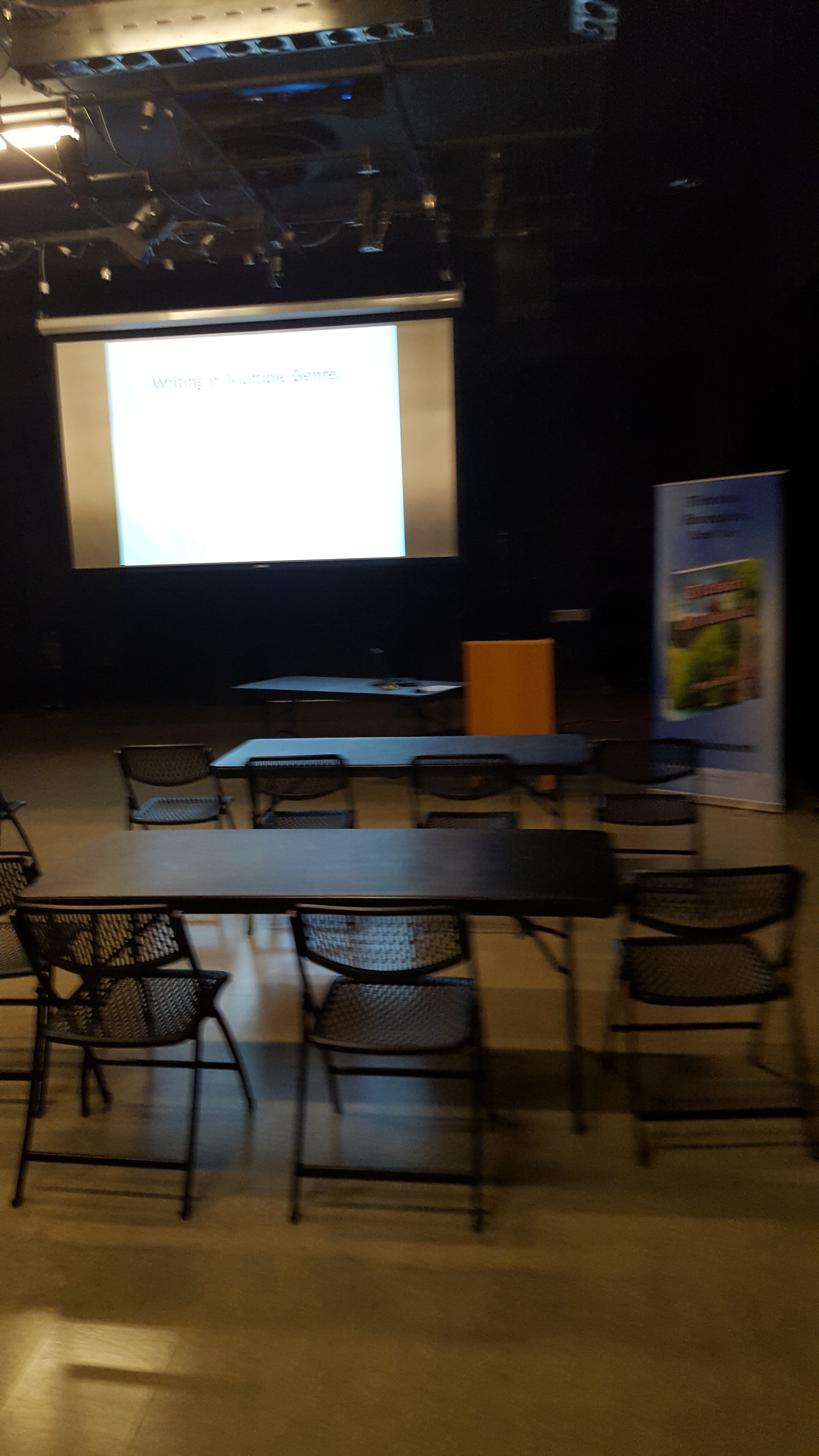
Yup, my book banner, right next to me at the podium.
Of course, I wasn’t done yet. Back at the desk full of pamphlets where people come through the door, I also placed business cards and bookmarks amongst the wyberry stuff as well.
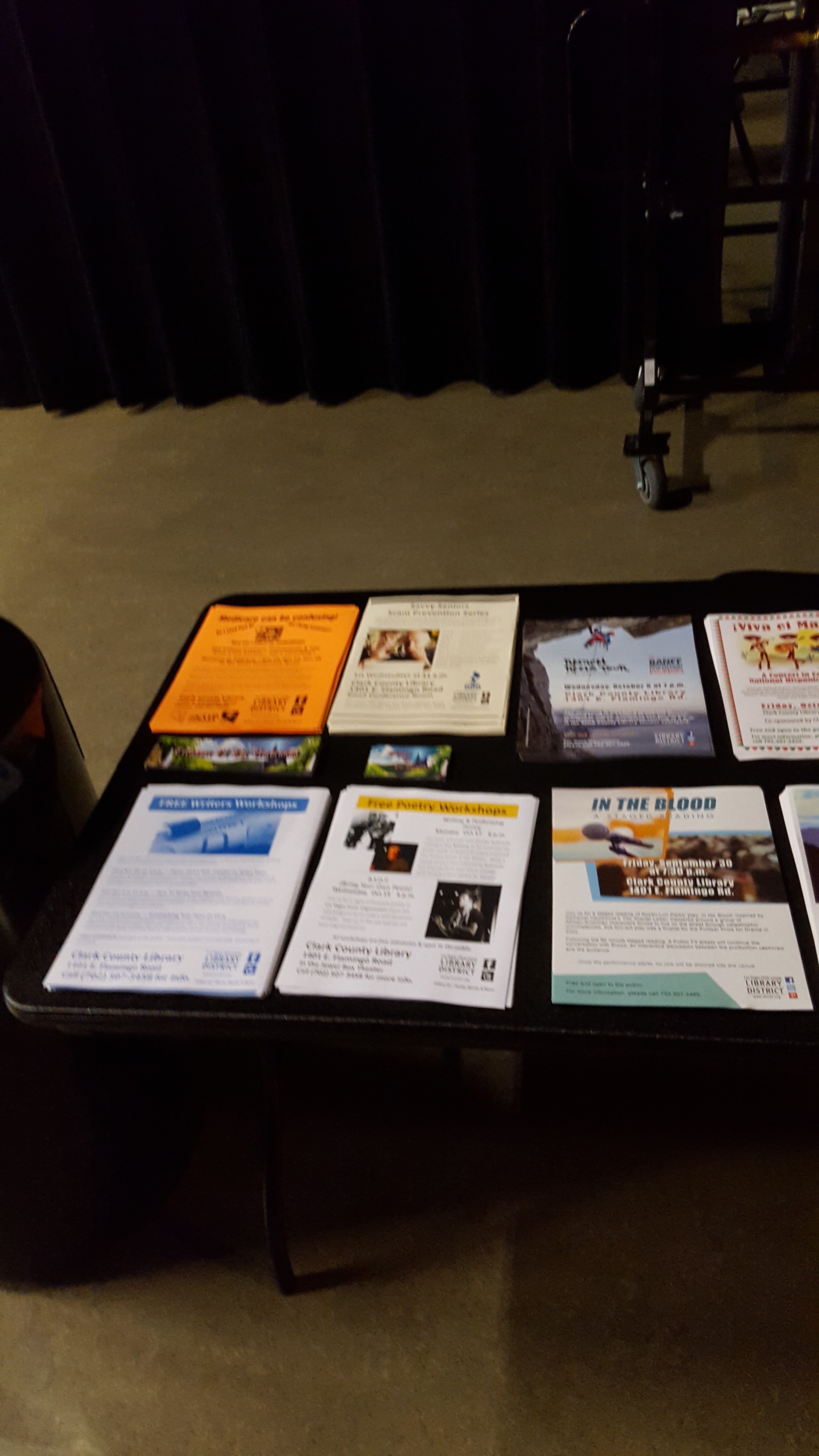
I didn’t have any flyers, but that’s another story I discussed in my article A Book Signing.
My presentation on writing in multiple genres went very well. I had fourteen participants. Inevitably, my book came up as an example and it was discussed multiple times throughout the evening, though Treasure Of The Umbrunna was not the focus of the discussion. Whether that helps sales, who knows?
My main point, though, was to promote writing in general and that’s what I did. As a writer, you should develop a platform and be prepared to do presentations in whatever form they may be. Maybe it will be just to promote your book. Maybe it will be some other passion that you’re interested in.
I happen to be interested in writing and I enjoyed talking about writing. I wasn’t just there to promote my book. I was there to talk about writing and as a bonus, pitch my book.
My presentation is available here for you to look at if you have Power Point.
Happy writing!
A BOOK SIGNING
And then, it happened!
Okay, I copped that infamous line from at least a dozen, if not more episodes of Sea Hunt. It was worth it.
It happened, alright. It surely happened (and don’t call me Shirley). If I need to tell you where I copped that line, well you aren’t no movie buff!
Anyway, I had my first solo book signing and at the risk of repeating myself, it was well worth it!
THE PRELIMINARIES
My solo event was organized by Barnes & Noble. The idea was to get as many people as possible to show up. The store pre-ordered a certain number of books, on the condition that my publisher accepts returns. That’s the big condition of a major retailer doing a book signing. Either you have to supply them the books, so they can sell them through their cash register at the retail price, which they don’t like to do because it isn’t in their system (more on that in a moment), or they order them from their supplier who accepts returns.
It’s not that retailers are so much against self-published books. However, when you self-publish, you have no distribution system. A large retailer deals with stock systems and distribution. This means inventory and returns etc. When you try to bring them something outside the system, it plays havoc with their books. In that regard, they just simply don’t like to deal with it.
In my case, since I did NOT self-publish, my book’s available through Ingram and Baker & Taylor distribution systems. Not only that, but it’s available through Barnes & Noble. At first, there was a glitch and it was cataloged wrong, but that was straightened out. When I got that cleared, the very nice lady in charge of things said yes to the book signing.
The difference between a small publisher and a large one is distribution. Because my publisher is not one of the top five, my book isn’t distributed to all the stores across the country. In that case, this local store ordered that set quantity for the book signing, on the guarantee the publisher would accept the returns. With that taken care of, it was a matter of pre-publicity.
Though Barnes & Noble posted the event on their web site, it was up to me to do my own marketing as well. I learned a few things.
First off, social media was by far, the best way to get the word out under these circumstances. I used Facebook and Twitter, even though 99.9% of my Twitter followers (1K+) don’t even live in Las Vegas.
On the other hand, I had some mailers and flyers printed. As for the flyers, I deliberately had them printed 5X7 because I figured the larger they are, the more likely someone would take them down from a bulletin board. The smaller size was more likely to stay up longer, even if they were smaller and drew less attention.
One little problem.
Have you noticed that almost nobody has bulletin boards anymore? I found that out the hard way! I went all over the place and found almost NO bulletin boards! When I did, I usually got “It can’t be for any money making event.” Say what???
Shot down in flames. I have a pack full of useless flyers and mailers. Oh yeah, about the mailers, I ended up just giving them to people that I either see all the time, or are already Facebook friends.
Lesson learned.
THE SETUP
The day of the event was tight. Since it was a Saturday, I unfortunately, usually have something going on with my astronomy club as well, and quite often miss my other writer’s group member’s book signings. I couldn’t very well miss my own! Right after this event, I had to rush home, pack my telescope and head to the north end of town for a public viewing session.
Anyway…I arrived at the store and they already had a table set up for me to the right of the main door, with my books displayed and a sign with a photo of my book. They also had a display screen with my book and name as you walk through that door above their Kindle display.
I brought my fold-out banner, my bookmarks and business cards. I also brought a note pad to write down complicated names for signings. I always do that in case someone has an unusual spelling of their name so I get it right, or if someone speaks softly or in a tone I can’t hear very well.
Finally, a key component, to attract extra attention and for a conversation starter, I added a candy bowl.
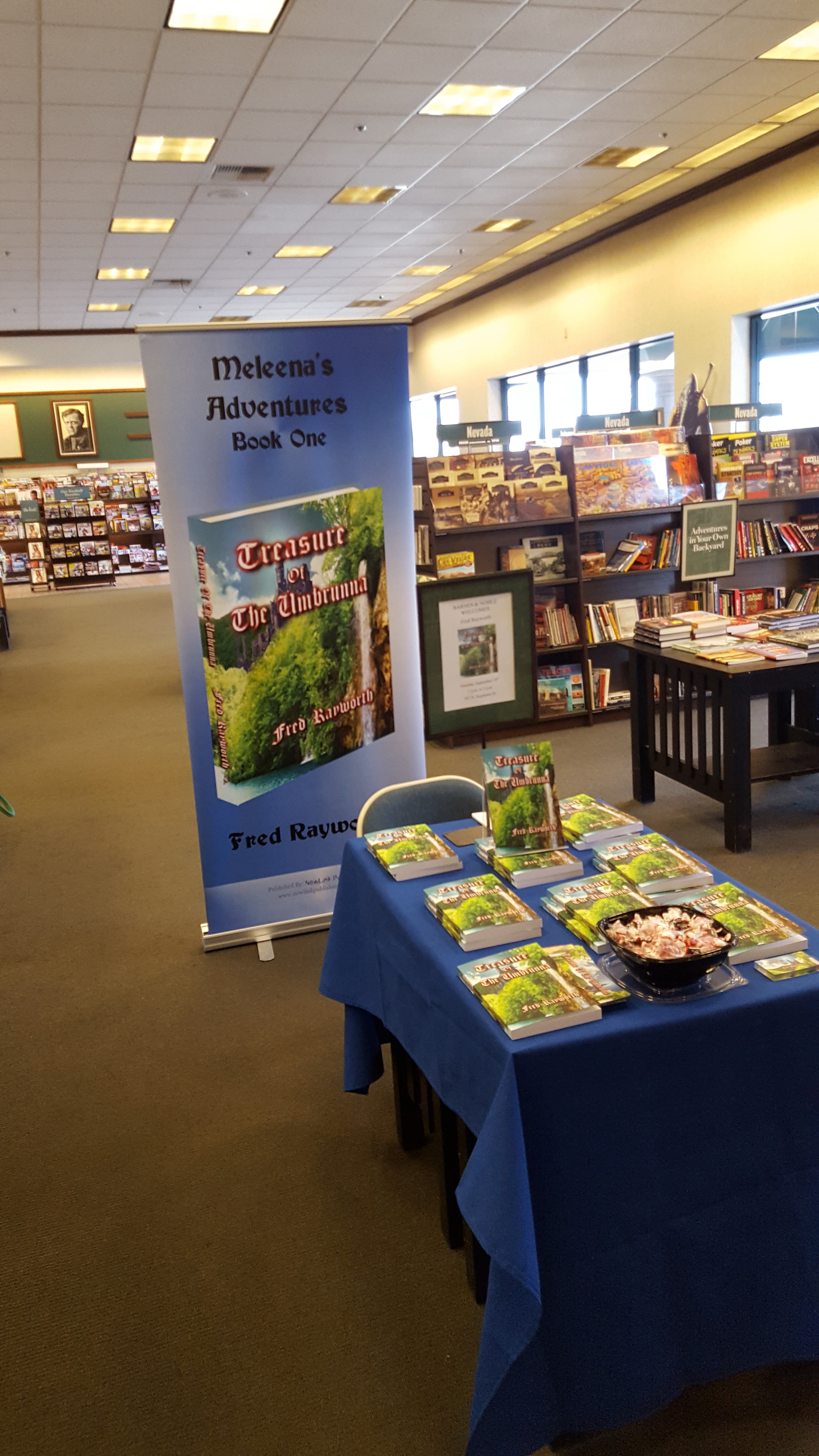
The store ordered fifteen books.
THE EVENT
The event went very well. The key to a book signing, now this is important, is to NOT sit at your chair (which they supplied) and just stare forward. Remember, you’re there to sell books, not wait for people to come and discover you!

Okay, right about where I’m standing, except I was on the other side of the table, is where I stood the entire two hours. I sat three times for about thirty seconds to rest my legs during lulls. When anyone came through that main door, which was to the right as seen in the photo, I stood and greeted people as they came through the door.
Some people avoided eye contact. I still said hi. Sometimes they responded, sometimes not. There are certain people you just know not to mess with. Some people are just shy and if you say hi and start talking to them, they respond. Some people if you say something, you can start a conversation.
Don’t be afraid to be rejected. Most will, but once in a while, someone will spark an interest.
The candy bowl was a great conversation starter. Sometimes it was just an avenue for kids. Sometimes adults with a sweet tooth. It made people hesitate.
I said hi to a lot of people. I found a lot of people didn’t read fantasy, but a few did as well. I explained the book to many. Some showed interest. Quite a few took my business cards and bookmarks, both which have the book title, ISBN and/or my web site.
RESULTS
As a result of my publicity, four people I know stopped by. Three bought a copy of the book. One stranger bought a copy as well. I went with no expectations. My goal was to sell at least one, so I outdid my expectations and then some!
That may not sound like much to some of you. However, consider how many book signings virtual unknown authors or even some very well-known authors go to where they don’t sell ANY books!
I think I did pretty well.
Oh…and I also got a maybe from one person who had to leave and catch a ride. We’ll see about that one.
In the end, the store asked me to autograph six copies of the book. The put “autographed by author” stickers on them and set all of the remaining books on a table by the door for a few days before transferring them to the local author wall in the back of the store.
I’ve been posting that on Facebook to let everyone know. Maybe some of those will eventually sell as well.
Folks, this is the life of a new author. Unless you’re up there on the New York Times Best Seller List, get used to it. You’ll be doing the same things.
Happy writing!
GET YOUR WRITING STRAIGHT
I’ve seen some pretty messed up, lazy writing and people make all kinds of excuses for doing so.
“Oh, it’s all about the story.” Yeah, sure.
Nobody considers that the reader has to suffer through this crap.
Nobody considers that readers may not be as dumb as some writers think they are.
Self-publishing can be good or it can be extremely bad.
Don’t blame it all on self-publishing. There are some conventionally published books out there with very bad writing.
Unfortunately, bad writers always point to these bad examples. “See? So and so did it, had a huge best-seller and did just fine!”
I don’t buy that. Sorry.
ALL OVER THE PLACE
Mary went to the store, idly browsing the pasta aisle. I looked at the shelf and told myself I’m going to get some spaghetti this time and I don’t care if Don doesn’t like it. I set the box of noodles in my cart.
Joann approaches and gives Mary the up and down. I hate her. She’s such a slut.
Mary noticed a presence behind her but ignored it. She knew who was there and doesn’t want to address the ho-bag Joann. She looks at another box of pasta.
Where do I even begin with this crap? Head-hopping? Mixing tenses from past to present? Mixed third and first-person?
This is the kind of bad writing I see plenty of in drafts, before editing, let alone stuff that actually gets published. Try reading 100K words of this!
MORE AND MORE NO RULES
More and more people are pushing, suggesting, down right advocating not to follow rules of writing because “all that matters is the story.”
You really notice it when you try to slog through a badly written tome then get to one where the author follows the rules and you breeze right through it. There’s a noticeable difference!
A noticeable difference.
People, getting lazy isn’t doing anyone no favors.
I’m not advocating being completely rigid, but geez, let’s get real.
When we talk about breaking a rule, we’re talking a little slip here and there, not out and out ignoring all of them!
As an author, why should you be the one accused of being functionally illiterate?
Think about it.
Happy writing!
OVERSATURATION
I was recently on a thread in one of my Facebook groups and a participant asked if anyone else though their fantasy genre was oversaturated.
Whatever genre or non-genre you write, have you ever felt that way? When you delve into your interest, do you feel overwhelmed by the amount of material out there? Do you feel like your swimming upstream?
THINK ABOUT IT
Say you’re a romance writer. Your focus is (naturally) on romance, so you concentrate on romance groups, other romance writers and romance novels. Ah, duhh. What do you think you’re going to find? Of course, you’re going to see hundreds, maybe thousands of novels in your genre.
What if you’re a literary author. Your focus is literary fiction. Guess what you’re going to find. “Literally” thousands of examples of what you’re up against.
Of course your field of focus is crowded.
OVERSATURATED?
There’s no such thing.
Since everyone has a unique voice, I go back to the Agatha Christie thing I like to use. Murder. There are so many ways you can kill someone with a gun. There are so many ways you can kill someone with a knife…poison…garrotte…polonium…what have you. They’ve all been done before.
The princess has been rescued a million ways before.
The bad guys have been headed off at the pass.
Folks. Everything has been done before.
VOICE VOICE VOICE
Why do these same stories keep getting told over and over again? Why do these supposedly “oversaturated” genres and non-genres keep getting more books published?
Simple.
Voice.
A unique voice and an unique way of telling the same old thing with a unique blend to make it that author’s own take is what makes every one of these stories different. Each individual author puts their own personality and voice into the same old same old and makes it something fresh and different. They add twists and turns and make them fun.
This is where you, the author, come in.
FORGET OVERSATURATION – PAY IT NO MIND
If you’re writing for market trends, or what you think will be hot, find another passion!
You need to follow your muse, follow your passion!
Forget about what you think might be oversaturated. Write what you feel and put your voice into it. You are what makes the story unique.
Happy writing!
INSPIRATION 2016
I make no secret of the fact that I get inspiration from the oddest places. I also talk quite a bit about it. This will make the fourth installation of my series on inspiration. What brought this on? As circumstances colluded this time, it happened to be the happiest place on earth.
DISNEYLAND
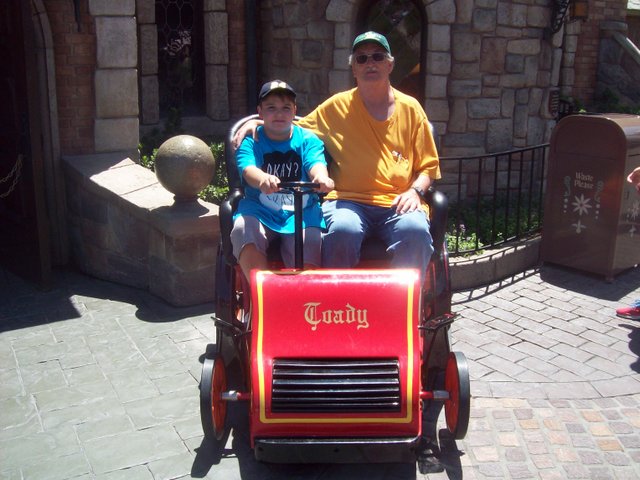
First off, I feel so fortunate to be close enough to visit a place I originally went to when I was four or five years old. I still remember sitting in a Toadmobile with my dad on Mr. Toad’s Wild Ride. Every year we’ve been able, since moving to Las Vegas, I’ve snapped a photo out front of the ride with my grandson. We sit in the Toadmobile they have out front when you come out the exit door.
I remember when Nikita Khrushchev tried to visit the park back in the late 50’s, I think it was, but the state department refused him entry, citing “security concerns.” That was total bull. They just didn’t want the commie pinko faggot junkie doper to get any positive publicity out of the park.
We used to go there every year or two the entire time I grew up in Southern California. Those trips to the Wonderful World Of Color are still a strong memory for me. In many ways, they inspired me even way back when.
There was the Zorro costume I wore around the trailer park we lived in in Lompoc. My mom made it for me. On one trip to Disneyland, I copped a plastic epee and went around stabbing everyone in the ass with it. Maybe the reason I still have a moustache today is because of the fake one I used to have back then, care of Guy Williams, the actor who used to play Zorro.
Then there’s the Zorro album, or more correctly, The Songs Of Zorro And Others which had a lot of classic TV soundtracks from Disney TV shows, almost all of which I watched on the good old black and white TV. I still have that album!
The park is pure fantasy, from the Cinderella castle:
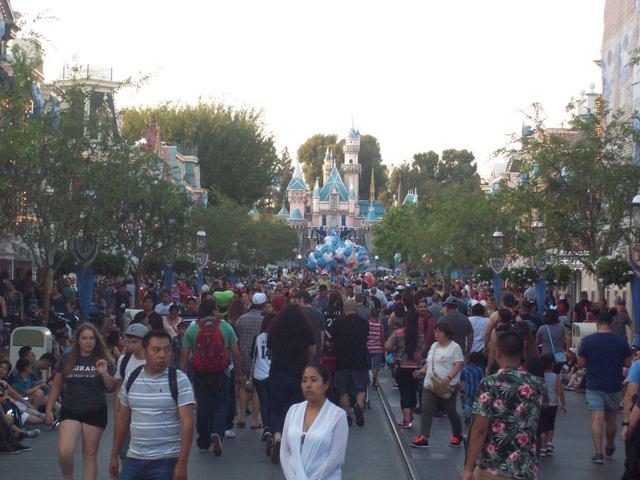
To the Matterhorn:

WHY NOW?
Since we go every year, why now? Why is this year any different? True, I’ve mentioned Disneyland in past installments of this series, but haven’t been able to act upon it. Well, I haven’t been writing anything new for quite some time. I’ve been editing stuff already written. That’s the biggie.
Though I’ve been writing these very weekly articles as well as my autobiographical articles for Let’s Talk Nevada, I haven’t worked on either my fantasy or adventure thrillers or even icky bug (as far as anything new) for a while because I already had stuff in the can, so to speak. While I like to catalog ideas in my head, I already had a bunch of stuff stored away in my mind for book three of Meleena’s Adventures. In fact, against my normal routine, I actually wrote a few key things down on a yellow sticky which is now hanging above my computer monitor!
Folks, that is almost unprecedented for me. However, given my new writing habits over the past six years, I’m forced to write at least a few things down since I can’t write several hours a day like I used to.
Now, since I just started book #3 of Meleena’s Adventures, having turned in book #2, Gods Of The Blue Mountains to the publisher last month after a very detailed self-edit, I can now concentrate on writing something new in fiction again (except maybe another one-off short story here and there). Since I’m in writing mode, I have the ability to pull things out of the air, even refer to the ideas I wrote down when the time comes.
INSPIRATION – WHAT DID I COME UP WITH?
Here’s where I have to be careful and not give away spoilers!
To start off, I got a huge slap in the face going through Pirates of the Caribbean not once, but three times. Yup, because we went on a slow day, we were literally able to walk right in after a five minute wait. So, we returned several times. We love that ride! Going through there, I came up with an idea. The second time, it became a little more solid. By the third time, I didn’t even need to write it down.
No, I’m not going to write a Pirates clone. It’s just the seed for something else.
The Haunted Mansion. Same thing. We went in and I got that tingly feeling, especially since the “doom buggy” kept stopping for one issue or the other. We went on it twice.
Now, the oddest inspiration came on the drive home.
On the northbound 57, the Orange Freeway, we got stuck behind a tanker truck with a bad decal job at 5 in the morning. I looked at those crappy decals with the incomplete letters and voila! I got the name for a character!
That one I did write down.
Folks, you never know where these things will come from.
Happy writing!
 The Worlds Of Fred Rayworth