INSPIRATION – WHERE DO YOUR IDEAS COME FROM?
I’ve always had a great imagination. That was evident early on when I was walking home from kindergarten one day. Yes, back in the 50’s, it was normal for kids to be able to do that, even in the Los Angeles suburb of Lakewood. I drew something in class I had yet to name. Some of the mothers saw me proudly flashing my fine work of art. They stopped me at the end of the cul-de-sac as I cut between houses on the way toward my house. They gathered around and admired my crayon scribbles.
“What is that, Freddie?”
I thought a moment and then it hit me. “It’s a polka-dot sewer!”
My mom, who was waiting for me by the front door, heard the peals of laughter. She walked down from the house to investigate.
I don’t remember anything else about that day. It was, however, the start of my illustrious career of telling tall stories. Not long after that, during show and tell, I told the class how my sister went down the drain after bath time. Somewhere, I have a note about that on one of my report cards.
I sometimes wonder if I had the writing chops back then, what kind of stories I might have come up with. I’ll never know, but I’m sure they would’ve been whoppers. What I do know is if I hadn’t pulled them out of the air, they would’ve started with some inspiration. That hasn’t changed. A great idea can originate in the strangest place, from the most mundane thing.
This may surprise you, but I get plenty of ideas from crossword puzzles. When I solve a word, I sometimes think, “Wow, I could use that word in a scene.” That little jumpstart may send me on a path of discovery.
Unusual or even normal people can inspire me.
Something that happens in my life can inspire me.
Books as well as movies, places and things inspire me.
Music plays a special part in my muse (a snooty word for inspiration). One thing I’ve always wanted to do is list all of my favorite bands at the beginning of each of my books. Music is a big reason I am a writer. I was never technically proficient enough at any one instrument (I‘ve played many), nor was I able to slap the right combination of notes and rhythmic meters together to create songs people would want to pay money to hear. I’m just better at writing than expressing myself musically. Yet many rock bands provide muses for me.
The 60’s and 70’s were especially fertile ground for my imagination with the psychedelic bands and the beginnings of heavy metal. I used to buy albums based on the band’s appearance rather than on what they sounded like. Most of the time, I was pleased with the sound and only once in a while was I disappointed in their music. Their musical journeys were their stories, with notes instead of words. It’s funny because though most of those songs had singers and lyrics, I hardly ever listened to the words. To me, they were just “articulated vocal noises,” to quote Frank Zappa.
Today, music still finds its way into my writing. I have a tendency to plug my favorite bands in my stories. Many of them are rather obscure so this is my platform to give them the recognition I think they deserve. They inspired me, so I’m returning the favor.
Music has inspired me directly. For almost a decade, I’ve been e-mail friends with Joanna Deacon and her husband, guitar virtuoso Tony McPhee from the British blues band The Groundhogs. Tony wrote a song called Bog Roll Blues on his great 70’s album Who Will Save The World. I wrote a short story with the same title. He and the “classic” band members from that album are fantasy heroes in the story. I sent it to him just for a hoot. It’s the only fan fiction I’ve ever written (and completed). They loved it (or at least loved the gesture).
What inspires you? What fires your muse? To be a writer, you must have the passion, that something that puts the fire in your belly. What is that drive that sets you on your path, that something that focuses you toward your goal? Is it media like music, movies, or other books? Is it the people around you? Could it be inspirational, emotional? Is it something that has affected your life in a positive or negative way? Whatever it is, grab it and don’t let go. Follow it. Find your own polka-dot sewer!
Research
Nobody can write something from a vacuum. There has to be some kind of source. True, a story can sprout solely from your imagination. There is nothing wrong with that. Fantasy is a good example. A memoir is another. However, even within those confines, the author must get the facts (whatever they might be) straight. In a fantasy, conducting a sword fight, for instance, may require a touch of realism. Slashing a sword against a monster is fine and dandy. What’s that going to do to the wrist of our hero? What about the weight of that sword? What kind of wound is it going to leave? Little things you as a writer may take for granted may stand out as a fatal flaw to the reader. Talking to someone who actually uses a sword would be a wise decision. What about your fantasy world? Are you deriving it from a well-established convention or is your world unique? By unique, I mean totally unique. It would have to be unlike anything else to avoid all research. Even then, it would be hard to avoid all laws of physics.
In a memoir, despite copious notes you’ve written in a diary, you describe something, yet missed a detail. Do you need to call that hotel you stayed at and find out the name of that suite? Or, what day was it that they served crab? What year was it that the town you visited in 1975 had a major fire? The one where you saw the burned out city hall?
Folks, when I write, I prefer to write what I know. It makes the research that much easier. I still have to look up details, but I don’t have to start from scratch. However, as I’ve stated before, I know where I want to start and where I want to end. Everything in the middle is a total surprise. Because of that, I sometimes write myself into situations where I have to make changes. That means my characters may originally travel to New Orleans but later, after a bit of digging, I discover they’re better off going to Morgan City. That’s why research is so important.
For a seat-of-your-pants writer like me, research can change where the story takes me. When I get to a spot where the facts don’t pan out, I take a different path. I still end up in the same place in the end. Sometimes the path doesn’t change but maybe I can’t determine the fine details. In that case, I follow my friend James Rollins’ advice. He once told me that if you can’t find out the exact details or if they’re too complex, be vague. You obviously can’t try to pull one over on the reader, but you don’t have to be exactly dead on with descriptions or minutiae. Don’t get into so much detail that you get yourself into trouble. Make sure what you do describe is accurate.
Research can be a lot of fun. It can also be frustrating, hazardous and expensive. The Internet is a great tool. I’ve accomplished a lot with a mouse and creative searching. On rare occasions, I’ve taken a short trip. Most of my on-location research has been from places I’ve already been. Like I said, I like to write what I know. I’m not the rich author that goes all out to take trips around the world just to glean some minor detail to throw into an adventure. Sorry, maybe one day, but I’m not on the New York Times best-seller list yet.
I’ve written people, interviewed them in person and talked to them on the phone. For the most part, people enjoy being asked, especially if they know it’s for a book. Once in a while, they don’t. Know when to shut up and back off. This isn’t life or death. This isn’t the CIA. I’ve visited a few people and places and had to cut and run, all to get a detail I didn’t end up using. For the rest, as a courtesy, it’s nice to remember who you talk to and acknowledge them in the front or back of the book.
If you’re writing non-fiction, the story is all about the research. No question. However, if you’re writing fiction, the story is the most important part. I read a lot of thrillers. In that genre, I’ve noticed a trend where there seems to be more importance put on the technical research and less on the story. The authors spend months researching and plotting out everything long before they ever sit down to write. Most of the time it works, but half the time, I feel like I’m getting a history lesson or I’m being lectured on politics or religion rather than getting a good story.
Ultimately, it’s up to you to set a balance for how much effort you want to put into research versus story. Are you out to entertain your readers with a good story, educate your readers, or a little of both? It’s a balance you have to decide. I’m not one for needing to include an extensive bibliography at the end of a fictional adventure story, yet some authors either do, or should. How many of you would actually read a bibliography?
Whatever you write, especially if it’s fiction, make sure it rings true for your genre. Do whatever research is necessary to make it real for your audience. If you do, it will not only make it real for them, but it will keep it real for you. If you don’t, the readers will surely pick up on it and they’ll let you know in the reviews. Check the one, two and three star reviews on Amazon. Discount all the ones that are there just to complain about Kindle this-or-that and look for the ones that say the author didn’t do their research. They stand out like a sore thumb.
“The author is a good storyteller but should’ve done at least fundamental research. He would’ve learned that that the town of Lompoc is pronounced “Lawm-poke” and not “Lawm-pock.”
“If the author had actually visited Russia in the new millennium, she would know that the KGB is no longer called the KGB.”
Nobody expects you to be perfect, but don’t embarrass yourself by making those big mistakes. Even the big-name authors slip up now and again with small stuff. There’s a reason they always have that “Any mistakes are solely the fault of the author.” disclaimer at the beginning of many books. They’re no dummies!
TIME TO GET STARTED: NOW WHAT?
Whenever you start something, there always has to be a first step. A starting point. So far we’ve talked about already being there. You’ve already had something to show, to have criticized and torn up by fellow writers and strangers. Where do you start? How do you start?
The simple answer is, to just sit down, fire up the computer (or a pen/pencil and pad of paper) and get to it. Sounds simple, doesn’t it? However, not everyone can just burst forth with verbal diarrhea at the drop of a hat. For some, it takes a plan.
First off, there has to be the desire to write. Since you are here reading this, that is a given. Second, if you are reading this, you at least have the ability to read so you also have some inkling of how to put sentences together. However, that doesn’t mean you can put them together coherently. Most people with a desire to write have had some kind of training or education that moves them (or pushes them) in this direction.
I strongly suggest you take a few basic writing courses either on-line, at a local community college, or even through a senior center. Learn how to put basic sentences together in a coherent fashion. Just reading them doesn’t mean you can write them!
Let’s assume you have the basics down and you’re ready to start. We’re back to square one again. How do you go about it? What do you want to write about? I can only speak for myself, but I’ve found the best thing to do is just start! That’s it.
Many people start out writing by keeping a personal journal. A recent example was Mary Wilson from The Supremes. She was our guest speaker a few weeks ago at our Henderson Writer’s Group meeting and she started writing a journal early in her life. She still writes almost every day. She’s turned it into several books.
When I sit down to write a story, whether short or long, I know two things. I know where I want to start and where I want to end. Everything else in the middle is a total surprise.
That, my friends, is my method. It surely doesn’t work for everyone, but it works for me. Below are some other methods that may work for you but don’t for me. I’ll explain why.
Many people must plan out their work ahead of time. Outlining is a good example. This type author meticulously outlines their story, chapter by chapter. That way, they are sure to leave no plot holes or gaps. They can find flow problems and all the bugaboos that can cause a story to run flat or hit a brick wall. That may be your path to success. For me, that is the perfect way to kill my creativity, lose my mojo.
At one of our writer’s group meetings, we discussed this one successful female writer. She would write a sentence and agonize over it, rewrite it and perfect it before she went on to the next one. Screech! Stop the presses! In text speech I’d have to say OMG! That’s “Oh my God!” for the rest of us. Talk about sucking all the creativity right out of a story. I just can’t imagine writing a story that way. To this day, I can’t remember that author’s name, but it worked for her.
We have a member of our group that started a wonderful story and I really enjoyed reading and critiquing it. However, he became so hung up on the mechanics of writing, he not only stopped writing that story, he stopped writing altogether because he didn’t think he was good enough yet. I kept telling him to just let it flow and worry about the details later, but it took him a long time to finally come around. I am happy to report that he is finally writing again. Please don’t let that happen to you! He is a truly gifted writer and I see great things for him, just delayed for a while.
This is how MY process goes. I have an idea. I stew on it for a while. After a few days… weeks… months… it all comes together. That inspiration. The spark. The beginning and the ending. When that happens, I may be in the middle of several other projects. I may have nothing going. I may stop what I’m doing if this inspiration is that intriguing. Whatever the case, I just go for it. I guess you could say I follow my muse, whatever that may be.
If I were to sit down and map it all out, the whole process would come to a screeching halt. It would just not work for me.
However, I am NOT you! What do YOU need to do? Do you need to just sit down and start writing your story? Or, do you need to sit down and map everything out? There are good reasons to outline a story. If your story involves a lot of research, it would be a good idea to gather that information first. As for me, I try to write what I know and if my writing leads me to something I don’t know, I’ll stop and do the research at that point. If it doesn’t pan out, I’ll change the story a bit. It still will not affect the final outcome.
You can’t know everything. No matter what you write or what method you use, there will come a time when you will have to research something. That brings up a great point and will become the subject of my next article.
I am very happy to introduce my very first guest blog. I met Fiona Dodwell through the Absolute Write Water Cooler web site. She is one great lady and an outstanding horror author. Fiona has agreed to do an interview for me to post here.


Fiona Dodwell lives in the UK, with her husband. She currently works part-time in psychiatry, and writes passionately during her time off. She has studied theology, psychology, drama and film studies. She has been writing since she was a child; writing short stories, poems and entering writing contests filled much of her time. Her first novel, The Banishing, was released in March this year, and her second novel, Obsessed, is due for release in September.
Fiona Dodwell on The Banishing
Can you tell me a bit about your novel?
The Banishing is a horror story that explores the dark subjects of demonic possession and domestic abuse. Here is the synopsis:
When Melissa first notices the change in her husband – subtle at first – she thinks it may be the stress of moving into their new home. Or working long hours. But soon he turns into something far darker, far more sinister.
Who or what is the dark shadow living beneath her husband? What is haunting him?
Melissa must quickly find the answer to these questions, because Mark is changing, and fast. Soon her fight will be for her life, as well as for her marriage.
The Banishing is a dark, disturbing novel exploring the world of demonic possession, spiritual oppression and domestic abuse.
Can you tell me what inspired you to write The Banishing?
The idea for The Banishing didn’t hit me like a strike of lightening – it was an idea that simply evolved over time. I had been reading testimonies from those that claimed to have been possessed by demons, I had also been reading literature on the subject of demonology. I found the idea of somebody being possessed by an entity purely terrifying – especially after reading The Exorcist and watching the movie, The Exorcism of Emily Rose. I wanted to create a story about a modern day possession that felt real, gritty, realistic and close to home. I wanted to create a horror story that was distant from the drama and special effects that people have come to expect from such a story; to take readers by surprise.
You seem fascinated by ghosts, demons and the paranormal. Can you tell me more?
I’ve got quite a morbid fascination for these topics. Even as a child, I studied paranormal literature, watched documentaries, read case studies and reports of hauntings and possession. Today, I’m still heavily engrossed in these subjects – I’m a staff member at a paranormal web site and I have attended some paranormal investigators evenings. I’m learning about these things all the time. I can’t honestly say why I’m drawn to these things – it’s something I’ve been drawn to for as long as I can remember. The idea that spirits roam this earth, that they seek to contact us, and the theory that demons exist and want to possess us simply amazes and terrifies me. My work often touches upon these things.
How did you find writing The Banishing? It does touch upon some dark issues. Did you find this difficult?
The Banishing was a difficult book to write. I had times when I just wanted to omit certain scenes or change the direction of the book, but I felt drawn and compelled to move forward with it, despite those feelings. Melissa, my main character, goes through hell. There were times I just wanted to get her to pack up and get out of that house, away from her husband, but somehow that wasn’t the story that wanted to be written.
I wanted to explore the reasons women might stay in an abusive relationship. It does happen, unfortunately. I wanted to explore my character, the way her mind works. In the book we find out she lost both of her parents in a tragic accident some years before. She is quite a solitary person. She is clinging to her marriage because, at times, she feels it’s all she has left.
Domestic abuse aside, I wanted to explore spiritual oppression and demonic possession. As someone who has long been fascinated by such subjects, I wanted to take the idea of an abusive character and take it down a different route: Is he being influenced? Possessed? Are there demons in the house or in his mind? I’m hoping these twists take the reader on a new and original journey. Mark’s behaviour does become different from that of a ‘typical’ abusive relationship, as readers will see.
Why do you like writing horror? Tell us of your fascination with horror, ghosts, the occult, etc. Are you a fan of the genre? What writers do you read, and who would you compare yourself to?
I have been fascinated with the paranormal all of my life. I can’t remember a time when I wasn’t interested in the subject. I grew up reading accounts of hauntings and demonic possession, I joined online communities to discuss such topics, and I am also a member of the staff team at Talk Paranormal.
The writers I enjoy reading? I love Stephen King, Christopher Ransom, Bill Hussey, Adam Neville, Stephen Leather, Susan Hill and Edgar Allan Poe. The list goes on! I also enjoy non-fiction books on the subject of the paranormal and occult. I highly recommend Hostage To The Devil, by Martin Malachi.
What is next for you?
My second novel, Obsessed, is due for release in September this year. It’s a ghost story that also tackles issues about post-traumatic stress. I am also busy working away on my third novel, The Shift.
Where can we find out more about The Banishing and your other work?
My website is the best place:
www.fionasfiction.wordpress.com
You can also email me with any comments or questions at:
BETA READERS
You’ve found a decent writers group. It’s been a year now and you’ve been able to read almost every week. You’ve read your entire manuscript and you’re getting the feeling you have a top-notch novel ready to submit to the world.
The problem that you now face is that though you may have some great individual chapters and your writing has improved tenfold, there is still one important element missing from the equation. The big picture.
Your group has heard your novel over the span of a year. Some may have heard all of it by now while others have only heard bits. During that time, they may have given opinions and advice that are a bit myopic. They may have said that one character should have done this or done that while you defended some action as justified because this or that happened, or because something is going to happen later in the book. You forget to check up on one detail and before you know it, the logic of why your character did something or why something happens gets lost in the shuffle.
For instance, during one critique of a critical chapter, you may use a certain dialogue tag that bugs one member and your critique time is taken up with a discussion on that aspect of dialogue tags, while an important plot point that you should’ve been called on is missed.
This is where you need to cultivate friendships with other members of your group. You need a few trusted friends that are willing to be beta readers. A beta reader is someone willing to read the entire manuscript from start to finish. This someone must be willing to read it as a whole and critique it as if they were reading it for the first time. Remember, screen out those “tough love” types! You don’t need any of that grief.
A good beta reader is someone that will read the entire MS (that is short for manuscript), look for the plot holes and other flaws, and let you know what is wrong with the big picture. They may also look for superficial grammar problems if you want (called line editing), depending on the person, but that is not necessary. The idea is to get someone to look for the plot holes, flow and consistency, issues that can make your story come to a screeching halt. These are the things an agent or editor will zero in on. These problems can kill your chances when you submit. A plot with a fatal flaw is no plot at all.
Remember that second set of eyes? This is where it really counts. Your best bet is to find several beta readers. I have two and sometimes three trusted people that I trade MSs with. We read each other’s work and perform the “stink test.” It can save some embarrassing moments. As writers, we are all in this together, so find those few you can trust to tell you straight and trade favors. It is well worth it!
This And That
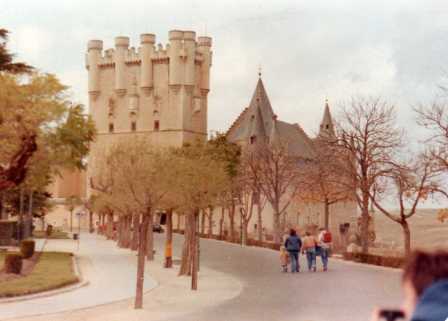
Since I started my official web site a few weeks ago, I’ve had a few people ask me about the image in my banner. It is a highly cropped photo I took in 1983 of the Segovia castle in Spain. The Segovia castle is what I consider one of those Disneyland castles and is my favorite of all the castles I’ve visited in Europe. It was about a two hour drive from our house and was a great day trip to visit not only the castle but the town with it’s winding streets and the ancient Roman aqueduct.
The castle is open for tours and today is the home of the Spanish military archives. It is also the place where Columbus asked Queen Isabella for permission to sail to the new world.
Right inside the entrance is a little door to the side that is now locked. However, back in the early 70’s, the first time I was stationed there, it was possible to sneak down there. A winding staircase leads to the dungeons under the castle and you can get lost down there as they go on forever!
This is the whole photo, in case you’re curious.
That’s all for now.
Forest Through The Tees / Critiquing
FOREST THROUGH THE TREES
Why is it that we learn all the “rules” of writing, yet we still cannot write perfectly? That is a question I hear more and more from new writers. No matter how hard we work to edit and perfect a sentence, paragraph, or whole story, we never get it quite right without external input.
The simple reason is that we are too close to the story. We can’t see the forest through the trees. As tired as that old cliché may be, it is still the truth. When we are too close to something, we see what we are thinking rather than what we wrote on the page. Even professional writers are wise to have a second set of eyes look over their work. The longer the work is, the more chances there are that they will get something wrong.
The point is this: do not beat yourself up for getting something wrong. Whether it be a misplaced comma, a tautology, or a passive phrase, just fix it when someone else points it out. No big deal. No matter how much you write, you are going to make mistakes. For those of us that have been at this a while, it’s a fact of life. You cannot have an ego when it comes to writing!
CRITIQUING
As a writer, if there is any way possible, I highly recommend that you seek out a writer’s group. A writer’s group can be two people or fifty. The key is that these people must be nice people! The point of getting together is to help each other out. Helping is giving good advice, opinions that will help you and your fellow writer improve their craft. This does not mean demeaning them, intimidating them, or embarrassing them. I have been-there-done-that. It is ugly, and doesn’t help. The “tough love” argument is just an excuse to be mean.
Some of you have heard my example of the writer’s group from hell. It is ultimately unproductive and destructive to be part of a group like that unless you are a masochist. I have yet to meet a successful agent, editor, or publisher face to face that is that mean and cruel. I have met a few, mostly through the mail, but they don’t make it far in the business and as the more successful ones know, it is just plain bad for business. Don’t ever let anyone convince you that being a “tough” critiquer is the way to go. I hate to quote another cliché, but you get more with honey than vinegar.
Critiquing should be objective, not subjective. Critique the work, not the person. Sometimes, it can be tough, especially if you find the material objectionable. If it is that bad, maybe it’s best just to defer rather than say anything. There was one case where a lady read some material that really got under my skin and I wanted to shout out “bull!” But I held my tongue. I thought about all the times I read some of my icky bug, a genre where I use a lot of “colorful metaphors” and a bit of gore and violence. Some members of our group are a bit religious yet they gave me objective critiques. I kept that in mind as I sucked it up and gave her an honest critique of her writing instead of her content. Luckily, she did not come to too many meetings, so I didn’t have to bite my tongue. You may run across this in a group, but that is just part of the deal. Not everyone is going to be a fan of your stories. Critique the work, not the person!
When you read before a group, you are presenting many new eyes and ears with things you can’t see, no matter how many times you’ve read and re-read your story. Trust me on this. You are too close to it. Your jaw is going to drop when someone will point out something so obvious. For instance, your villain pops a few shots at the hero with his silenced revolver, misses and steals away. Screech! Halt! Any gun enthusiast will tell you, you can’t silence a revolver!
That was a rather blatant example, but you get my point. Your audience will catch repeated words, run-on sentences, misplaced modifiers, characters names changing from one section to the next, the list goes on.
Next we’ll talk about manuscript, or beta readers.
Dealing With Harsh Criticism
This article is a piggyback to Humility. It was originally posted on the Henderson Writer’s Group newsletter either last year or the year before and I thought it would be good to re-run it here to supplement my first post.
Many of us that have been in this passion for a long time have had to deal with harsh criticism at one time or another. It’s inevitable that if you submit your work either to agents, publishers, or other people, someone is going to come along that doesn’t have a smidgen of tact or compassion for your feelings.
When I first came to Las Vegas, I was in the writer’s group from hell. They used to meet at the Borders at Lake Mead and Rainbow in 2002. I’ve never publicly narrowed it down before, but since I keep bringing this shining example up in other discussions, I thought it was time to let the cat out of the bag. I have yet to run across one of those people since then, anyway.
This group was based on “tough love.” The philosophy was that they were supposed to intimidate you, put you down, and make you feel as bad as possible, to “toughen you up” to the cruel world of publishing. That may not have been the actual intent, but that was the result.
The point of going to a writers group is to learn and get honest feedback on your work. If you leave every meeting mad, intimidated, and disillusioned, what is the point? At the last meeting I attended, I told them I’d be back, but as soon as I walked out of there, I realized there was no way I was returning to that kind of abuse. Whatever valid points they had were buried in all the negativity. If anything, they likely discouraged many unsuspecting new writers from going for it.
Nobody needs to take that kind of harsh criticism. That is not the way the legitimate publishers and agents work, and I’ve only run across it once in all of those 615 rejections I’ve received, so far (actually it’s 659 so this article is pretty old!). I’d entered a writing contest with Palmdale Gold and when I lost, I asked if they would take the time to let me know why. I got this “tough love” diatribe on how I didn’t know a thing about writing, should go to school and learn first, and throw the whole premise of my book away. That publisher subsequently went out of business.
I’m here to tell you, if you love writing, if you HAVE to write, don’t let something like that get you down.
Funny, after I published this, I remembered some rejections I’d forgot about and my statement about only receiving that type of harsh criticism once was not true. And it has happened since then also. Luckily, it doesn’t happen often, but it will, so get used to it. And, remember that even when you get through all of that and your book is sitting on a shelf or is out there in the e-world, someone is going to hate it. Don’t take it personally, even if they do.
Now that I’ve beat this dead horse, my next post will be something about actual writing!
Humility
I’ve been thinking of a good first post for my new web site and the first thing that came to mind was a subject that I think all writers must learn up front. Humility. What do I mean by that?
As writers, we express ourselves through words. We tell stories, pour our hearts out, put our hearts on our sleeves for you, the reader, to slice and dice and tear us down without thought for our feelings, hopes dreams…
Okay, I’m laying it on a bit thick.
To some writers, what I just said is the absolute truth.
I’ve got news for you. In this sometimes ugly business, you have to develop a thick skin. When you write something and put it out for everyone to see, you must be prepared for unfiltered responses. It’s just like when a woman puts on a dress and her kid says “Mommy, you look fat.” Or when a teenage boy thinks he does something heroic and the girl of his dreams yawns and says “Joe, that was really stupid.”
Humility.
When we write, we have to be prepared for both sides of the coin, the praise and the criticism. No matter how hard you work at something, no matter how cool the inspiration, at least half of the people are going to love it while the other half hate it. Count on it. While one person is going to slap you on the back and tell you how great it is, the other is going to slap you in the face and tell you it sucks.
That is just the end result, what your final audience is going to see.
What about your peers, other writers? If you want to be a really great writer, I’ll repeat this—You have to learn humility. No matter how long you’ve been at this, no matter how much practice you’ve had, you are never going to be perfect.
As an editor, I know this first hand. I do a lot of editing for member of my writers group. In my 17 years at this, I’ve learned a lot about writing, both personally and professionally. I put it to practice. However, I also know that when you are too close to something, you can’t see the forest through the trees. I know that’s a cliché, but it’s true. I even wrote a separate article about it which will feature later on in my On Writing page. When I write, I try to follow all the rules I’ve learned over many years of practice. However, during my creative process, I follow a stream-of-consciousness and sometimes skip over a few of those rules. The idea is to get the ideas down while they’re fresh in my head. I’ll worry about fixing the manuscript later. I write much cleaner than I used to, but I still make many of the mistakes I find when I edit other friend’s manuscripts. Does this mean I’m a bad writer? Of course not! That shouldn’t mean you are either. That is what editing and writer’s groups and reading buddies are for.
When you write something and give it to someone for a critique, don’t get all bent out of shape or want to quit writing if you get it back covered in red ink. Humility.
If you are searching for someone to critique your work and they give you the “tough love” treatment, belittle you, give you harsh criticism, or make you feel like crap, run, don’t walk away from that person! You are NOT getting a good critique! There is a difference between constructive criticism and being demeaned by an asshole. The world doesn’t need these people. Trust me on this. If you consider sharing a manuscript with someone and you ever hear the words “tough love,” “brutal truth,” or “blunt honesty” in the conversation, you don’t need to be dealing with that person. You’ve learned one thing. They don’t have a clue how to be constructive and diplomatic. You’ll just get frustrated dealing with someone like that.
Say you find some great people, get past all the editing and your story or book is published. It makes it to Amazon and the reviews start rolling in. Now is where you see the real unbiased reviews by total strangers. They can be really good or very cruel. The cruel ones can be personal attacks, attacks on your writing style, holes in the plot or story that nobody else noticed, or something completely out of left field. My personal favorite is something to do with Kindle that has nothing to do with the story. Be prepared. Humility.
Writing has a lot of ups and downs. I’ve weathered the storm, so far. Here I am 17 years later. You can do it too. Just learn a bit of humility.
Welcome To My Web Site!
Either you found your way here through one of my stories or books, been harassed and badgered by me to come here, or was bribed by one of my friends or relatives. Whatever the case, I’m glad you are here.
Within these pages, you will find information about me and what I write.
When I started this obsession “hobby” in 1995, I had no idea where it would lead me, the kind of grief, joy, disappointment, thrills, embarrassment, or pleasure it would provide. I am now at a point where I am ready to present what I’ve accomplished to a much wider audience.
As you may notice from the bread crumbs above, I cannot seem to stick to one genre. The fact is, I love to write and am especially fond of genre fiction. Because of that, I’ve divided my web site into specific pages to cater to your individual tastes. In addition, I couldn’t resist throwing two non-fiction pages into the mix for my other passions, astronomy and woodworking.
So, relax, browse around. Let me know what you think.
Fred Rayworth
 The Worlds Of Fred Rayworth