FLOW IS KEY
In various forms, I’ve talked about this before. Story flow.
I read a lot. Okay, I’ve also talked about that a lot. The other day, at the most inspiring place in the world, Disneyland, a lot of things popped into my head, including the seeds for this article. Then that spark of an idea came to roost when I’d finished the book I was reading during that trip and started the one I’m currently reading (and finished last night), which had 152 short chapters. That made this thought come full circle back to what I’d read while stuck in the hospital.
Story flow. It can make or break your story.
First off, I’m not going to condemn every style I don’t like personally, but then again, I am going to explain why I think they’re a detriment to an easy and enjoyable read.
Being a writer is one thing. However, before we were writers, we were readers, true? I certainly hope we still are, because that’s the whole reason for taking up this passion, to make something readable either for ourselves, or eventually for other people.
Why torture your readers?
HERKY-JERKY
Digging up examples of past books I’ve read, there was the example of a recent science fiction novel I read. They style was herky-jerky, frenetic pacing. The author wrote in random thoughts, expected the reader to have read the previous two books, and buried the action, which was admittedly relentless, within that jumbled mess. In a way, the pacing was steady, but the writing distracted from that.
I’ve read other novels where they would start slow, pick up at a frantic pace, slow down, have a burst of action, then nothing for a very long time. Finally, they’d end with a small burst of action. The chapters were very long, like thirty pages or more, with no scenes.
To me, that’s as herky jerky as the sci-fi writer with the relentless pace.
SNAILS-PACE
This is getting more into the literate way of things. The pacing is almost non-existent as the author spends all their real-estate developing the characters. Plot is a side issue. The chapters are long, the paragraphs are very long and the narrative tends to be rambling.
This is a word lover’s dream.
When I was stuck in the hospital, I read a murder-serial killer story that moved at a snail’s-pace. Not only that, it had an unsatisfying ending. It was pure torture.
BRISK PACING
Though I’m not big fan of James Patterson’s novels, mainly because he tends to write first-person most of the time, the one thing I like about him is that instead of writing scenes, he writes very short chapters. His novels might have 80 – 100 chapters or more. A side effect of this is that he also tends to avoid head-hopping because he’s able to contain the scenes to single characters when he does write third-person.
This style makes for a fast-paced and easy read, especially if you read at commercials.
The current icky bug novel I just finished had 152 chapters and was a pure pleasure to read. Fast-paced, it was solid third-person and there was no room for head-hopping. I loved everything about it except the ending!
You don’t have to write hundreds of short chapters to have fast pacing either. You can do it with multiple scenes, or even just relatively short paragraphs.
You can do it by not rambling.
You can do it by getting to the point.
You can do it by moving the story, even if every scene isn’t a chase scene.
All you have to do is pace the story. By that, I mean give it a steady buildup to the climax. Make sure something is happening in every scene. It doesn’t have to be thrills. Keep the genre in mind, of course. It has to be something significant to move the story along and it has to be some kind of action (movement), no matter what kind of story it is.
WHAT IS ACTION?
By action I don’t mean necessarily action/adventure as in the genre. I mean, the characters have to do something significant to move the story. That’s it. Forward pacing. NOT backward pacing.
Think about it.
You have a story about two little old ladies getting ready for a quilting bee. They’re mild rivals. They get together to check out each other’s work. Now is not the time to go into a long diatribe about how they went for ice cream when they were nine years old. Okay, maybe a couple of sentences, but not an entire chapter, right? Pacing.
These two old ladies have an interplay where they examine each other’s work and mildly, or maybe harshly criticize each other’s work. Bla Bla Bla.
Story movement. Conflict.
Notice how I deliberately picked a genre I don’t write, just to illustrate my point.
That was an action scene that moved the story forward, demonstrating their rivalry.
WHAT IS NOT ACTION?
Overlong descriptions.
Going off on a side story.
Going off on a rant.
Unrelated back story.
Unrelated flashbacks (see back story).
Every one of these things may have action in them by definition, but they’re not action that moves the plot/story forward. The slow the pacing and jerk the reader out of the main story/plot/main action.
I’d also like to add overlong chapters and paragraphs. Overlong sentences also don’t do you any favors, as well as lack of scene breaks.
The idea is not to torture your readers. Your story is supposed to be a pleasure to read.
Finally, don’t throw the dictionary at them. ‘Nuff said about that one.
SUMMARY
Keep in mind that as much as you like to write, one day someone else may want to read it. Don’t torture them (or an editor)!
Happy writing!
SO, YOU THINK YOU CAN DO IT BETTER?
Since I brushed on that subject in my last post, I thought I’d dig a bit deeper this time.
For a while, and maybe even now, some writers decided to get into this place your description here because they read a lot and thought they could do it better. I said before that I once thought that as part of my reason for becoming a place my description here writer. It was a very fractional part. My main reasons for becoming a writer was that I found my muse, I loved to do it, certain writer’s inspired me (not despite them), and I had a natural inclination to just sit down and git ‘er done.
For those reasons, writing became a passion, rather than a hobby. I can say the same for telescopes and visual observing, which is more commonly known as amateur astronomy. It has been a lifelong passion, rather than a hobby. Both of these passions are in my blood, not some passing thing that I can take or leave.
IT’S HARDER THAN IT LOOKS
Okay, you went to a few writing classes, you’ve picked up a few chops. Now, you’ve read quite a few books and seen numerous examples of lousy writing, some of them probably best-sellers. Think you can do it better?
There’s a few things you need to know. Now, if you’re an experienced writer or author, I’m not telling you anything new. However, if you’re just starting out, this is especially for you. If you’ve been at this for a while and may have “fergotted,” well, let me remind you.
Though you may be a decent writer, when it comes down to putting it on paper, or dashes and zeros (electronic media), there’s a huge difference from what you think and what gets down! What you think you wrote and what you actually write don’t always end up being the same thing.
What about editing? Sure, you can polish and polish, but though you may get the grammar and syntax just right, there may be a huge issue still missing.
Story.
What if you get all that right and you have a great book? Well…
THE REALITIES OF THE PUBLISHING WORLD
Just because you’ve written the most fantastic book since sliced bread, don’t expect the world to notice. Trust me on this!
While that piece of crap you scoffed at might end up a best seller, your fantastic tome can’t even get past the slush pile of an agent or editor anywhere in the good old You Ess And A, Jolly Olde’ Englande’, the Great White North or Tibet.
Why?
The reasons are too numerous to list, but let’s try a biggie.
Dumb luck.
There are thousands upon thousands of fantastic stories written by highly skilled wordsmiths in every genre imaginable that will never see print because of a multitude of reasons. One of the biggest is just plain luck.
WHAT HAVE WE LEARNED SO FAR?
You may be light-years ahead of that schlub that got a piece of trash published and is making a killing (boy I could name a few), but the one magic ingredient you don’t have is luck.
MAKING YOUR OWN LUCK
There are plenty of masterpieces of literature, non-fiction and fiction out there in every genre and non-genre. There is plenty of crap. Why? Those people either stumbled into luck or made their own. How did they make their own?
The only way I know how to make luck is persistence.
Persistence.
Don’t give up.
If you want it bad enough, keep plugging away.
I have a file cabinet full of rejection letters and partial manuscripts. I also have, or had e-mail files of whatever rejection letters the agents and/or publishers bothered to return. Many of them didn’t. In total, whether they did or didn’t return something, I have 682 rejections to be exact, last count. It took me 20 years.
How long will it take you?
WHY ARE YOU REALLY DOING THIS?
My suggestion, which I’ve told many, many writers, is do not make a specific goal of a certain number of months or years, or number of rejections before you give up. To me, that is a complete fallacy. When I started this passion, that’s exactly what it was, a passion. I got in this because I found my muse, it was easy for me and I love to write. Because of that, writing is always first. Therefore, getting published is always second. Sure, I’d like to, but despite trying and trying and seeing rejection after rejection, not once did I ever set a goal to quit. I’ve continued making my own luck and writing story after story because I love to write. It’s as simple as that.
It took twenty years, but it was well worth it. I’ve had a long time to hone my chops and now it’s starting to pay off. If I hadn’t got these two contracts, I would’ve continued to write anyway. By the time I croak, I might have a hard drive full of novels to pass on to the family. I really don’t care either way. I love to write and you as a writer need to keep that in mind before you start this. If all you are thinking about is business, you might consider something far more profitable and predictable.
Happy writing.
WHAT I’VE BEEN READING LATELY
I’ve said it before and I’ll say it again. Not only do I love to write, I love to read. I think Stephen King even said it. If you want to be a good writer, you not only need to write, you also need to read…a lot. I do both.
I don’t read for research. In fact, at best, any skills or info is something I pick up by attrition.
Why?
There are so many writers with good stories, but their writing sucks.
Then again, there are a lot of writers that not only suck at writing, their stories suck along with it.
On the other hand, there are some writers that write very well, perfect for me, but their stories suck.
You get all kinds.
Nope, I don’t read to hone my chops. I read for pure pleasure. If I pick anything up, back to the second paragraph. I pick things up by attrition. If I want any writing tips, well… I used to have a shelf with a few books on writing. I opened them up and leafed through them and never touched them again. Either the Henderson Writer’s Group has them in their wyberry, or I took them to Goodwill.
The only books on writing I have ever kept are reference books. Now those, I’ve actually used. Chicago Manual of Style is a good example.
Now to the point.
BOOKS I’VE READ
As usual, I won’t go into specific titles because I don’t want to slam other authors here. I leave that to my honest and blunt (I try not to be brutal) reviews on Amazon. I also make no bones when I love a book and the majority of my reviews are four and five star.
The past few months have been mostly good ones. However…
I picked up this one hardback, which was a mistake, because the back cover blurb looked intriguing. After leafing through it, I noticed it was solid third-person past tense, and it did not look omniscient. A trivial thing included a blurb by a noted author I like (sometimes).
What is it Ahnuld says in that movie? “Beeg meestake!”
This friggin’ monster of a book was a character study. Almost nothing happened…forever! When it finally did, what little action there was came to a screeching halt when the author went into a character study about one of the characters he forgot to delve into earlier. This was right near the climax of the action!
Then one of the heroes dies, which pissed me off. The real clincher was the ambiguous ending that didn’t resolve anything. I mean, it didn’t resolve a thing, literally, and I cringe using the term because this story was literal fiction in the extreme, though I think those of that bent might call it a potboiler (potbroiler?). In fact, some of the reviews alluded to that.
Okay, that was the one ponderous tome I was stuck with while confined to a bed in the hospital.
Another slightly quicker read was a science fiction story I took a chance on, because it was in third-person. Unfortunately, the style was frenetic and scatterbrained in approach and it was really hard to follow. Since I was confined to the bed, I made do, and suffered through it. The author assumed I’d read the previous two novels in the series, which I hadn’t, so I didn’t get a lot of the references, though he gave half-hearted explanations. As for the two previous books? No thanks!
Then there was a murder mystery by a female writer. I breezed through it in a single day. It was a pure pleasure to read! What a difference!
Right now, I’m reading a third-person omniscient thriller. I knew what to expect going in, so there were no surprises. It’s a lot better edited that the last one but still has some glaring mistakes. I love the story but the author insists on the dispassionate omniscient style and it is full of tell. I just have to live with it to enjoy what is a pretty good story.
DOES ANY OF THIS AFFECT MY WRITING?
Some authors I’ve known and heard of say they decided to take up writing because they thought they could do better than what they were reading. I’ve thought that once in a while. In fact, my inspiration to start was other writers, but not necessarily because I thought I was better than them. I just wanted to join them. After doing it myself now for so many years, I don’t judge others based on my own abilities. I judge other writers based on what I think of them as a reader, regardless of what I am as a writer. Can I do better than them? That is entirely up to my audience, not me!
All I can do is write the best I can, keep my integrity intact, and keep my standards intact. Whether it stands the test of time is up to everyone else.
Oh, and there’s also the matter of the actual story to go along with that!
Happy writing!
LAST MINUTE TWEAKS
We’ve all heard that tired old quote from the NRA’s dear old friend Charlton Heston about “cold dead hands” and some could say the same thing about a manuscript. When it comes to your “precious” (okay, another quote, and don’t make me say which movie), it seems like you can never stop until it’s literally (oh, what a cliché), pried out of your very much alive hands.
I’m going through that right now.
WILL THE EDITING EVER END?
I don’t think I’m revealing any huge trade secrets when I tell you that though my manuscript from Treasure Of The Umbrunna has gone through, not only my own personal multiple edits, tweaks and read-throughs, including with the Henderson Writer’s Group, it’s gone through three (or is it four?) complete edits by my publisher, once I succeeded in actually obtaining said publisher. Whew, I just broke a rule with a very long sentence!
What I can say is through all of that, there hasn’t been a single major change in either story line or plot. I was able to keep true to my polka-dot sewer (my muse) and use my usual – no – my only method of writing. I knew where I wanted to start and where I wanted to end. The rest (the middle) was a total surprise.
BY THIS POINT I’M NO NEWBIE
I must say that by this point in the game, when I wrote Treasure, I was no babe in the woods, cliché intended. I already had ten novels under my belt, even if they were all unpublished. The only one which might have plotting issues would be the first one, The Cave and even that one might be more of a problem with writing functionality rather than plotting.
It all boils down to fixing the numerous writing mistakes, tweaking minor things. Lots of them.
SO MUCH EDITING CAN CREATE MORE MISTAKES
With so much editing, even if the edits are relatively minor, which in my case, they were, making those edits can also create more errors. When all is said and done, a final run-through is essential!
My first edit was for structure and continuity, not so much for grammar. I made several tweaks and in the process, created some grammatical errors (mostly too many noun-verb combinations starting sentences). The second edit was for grammar and I made lots of corrections but in the process also created some other errors. The third edit was to fix the noun-verb combinations I created fixing the other issues. Along the way, the editor found more grammatical tweaks like show not tell and phrasing she thought would work better.
You have to remember that even though I can do the same thing to others, being an editor myself, and can also do it to my own writing in a limited amount (I’m too close to it), I need that outside eye to see it (forest through the trees).
With so much red ink, through multiple edits, when the final draft came down, prior to printing, there were bound to be slip-ups and things we all missed.
True to what I figured, I found pages of errors on my error sheets (there are 25 lines per page). In total, the count came to almost 300 line items.
LAST CHANCE
I now have the last proof before it goes for the first printer galley. This is the time to do as many tweaks as humanly possible.
I want this book to be perfect before any readers get hold of it. Though I strive for perfection, I know deep down I’ll probably miss something. It goes with the territory. The more I catch now, the less I can be embarrassed about later.
GOAL
This is a difficult process to get right, or as close to right as one can. I’ve read books out there that were essentially perfect. Others looked like they were skimmed over with spell check and the author/publisher/editor(s) didn’t even catch all of the red-lined words!
My publisher is small, right now. I want to do them proud. I’ve seen some of the big ones put out total crap. I want to do much better than that. My goal is for the reader not to be able to tell the difference in editing between my book and one from any of the big houses.
I don’t consider that a lofty goal. It’s just a matter of effort.
Happy writing.
MORE SOCIAL MEDIA OUTLETS
I’ve been stumbling along, learning as I go, imparting what wisdom I can to you, my readers as I go through this process. Hopefully, this will make the journey easier for you if you haven’t already done it and aren’t sitting back and laughing at my misery!
My publisher sent me a checklist of things I needed to do before, during and after my book is published. Though I read through it once, twice, three times, not everything sank it due to being overwhelmed. I had to take things a little bit at a time. Also, there are certain things I physically can’t do due to my job and finances. However, there are avenues I can pursue that allow me leeway to get the most bang for my buck (that includes time and effort).
A lot of that bang comes from the effective use of social media. After read-through #3, more social media things have soaked in. This week, it was Facebook and Pinterest.
Okay, a lot of people have a Facebook page. I’ve had one for years and I’ve used it not only for personal stuff, but to plug my various writing projects like this web site and Let’s Talk Nevada, among others. However, one thing I didn’t think about, even though I’ve seen and even liked numerous times, was people who had dedicated Facebook pages for their books! I guess I knew it was possible but it never dawned on me how easy it was until my publisher prompted me through her things-to-do-list, that I needed one. When I finally dug around on my toolbar at the top of my personal page, I found the create new page thingie and voila! It was really simple.
The problem was making those critical decisions of how to set up the page. Once I did that, it wasn’t so bad. Since Meleena’s Adventures is a series, I went from there.
Now I have to start inviting people to the page and make links to this web site.
This site is a bit more tricky. My editor recommended I join it a long time ago, but I kept hearing from others that it wasn’t a very useful site. Once again, it was one of the suggested but not mandatory sites listed in my to do list. I finally broke down the other day and signed up. A complete novice, I still have no idea what to do with it. I don’t even have a log in or anything. In fact, I don’t have a link to get into it. I have lots of e-mails to the account and that’s the only way I can get into it, so far. I’ll figure it out.
LINKS/LOGOS ON MY WEB SITE
One of you readers suggested I put Facebook and Twitter logos/links on my home page. I love that idea and finally figured out how to do it through widgits. I had a brief distraction where I was in the hospital so I lost some time and now that I’m back, I’m going to investigate more things I can do with social media.
GETTING CONNECTED
The key with social media is to be present, get linked up everywhere, and communicate.
It’s certainly not the be-all/end-all for marketing but it does help get your name and book out into the world.
Happy writing.
HOW DO YOU FILL IN THE SOCIAL MEDIA GAPS?
A mantra I’ve heard over and over again since I’ve entered the crazy world of social media is that not only do you need to participate in the most popular sites, but you need to keep a steady output. When you disappear for a while, people tend to forget about you.
To me, that presents several problems.
BUILDING UP A STOCK OF ARTICLES/TWEETS/WHATEVERS
For some people, this could be a nightmare. For me, I already do that, especially with my weekly Let’s Talk Nevada autobiographical articles and sometimes even with these weekly (I hate to use the term blog) articles. However, Tweets? I’m sure I could, but haven’t thought of enough witty tweets to stock up on yet.
I recently started doing What’s Up With Meleena micro stories that I post at odd times on my Meleena’s Adventures page here on the site in anticipation of the publication of my novel Treasure Of The Umbrunna. However, I usually write them on-the-spot. That’s the same for many of these articles on writing. I should build up a stock of them but I like to write off the cuff and when the muse strikes. That often happens late in the week.
Some of you might find this a huge issue, especially if you have a hard time just keeping up with your regular novel writing or whatever you write. If you work, are a homemaker, or have a hard time finding you muse, building a stock of work could kill your social media presence. Then again, a writer is supposed to love to write, so…
On the other hand, not everyone uses social media and not everyone has become a huge success depending on it either. It’s just another avenue. We’re not here to discuss that.
Why should you have a big of articles/tweets/whatever always built up?
CIRCUMSTANCES
Most times, absences from the net can be planned in advance. However, what if not? Perfect example. I’m writing this tonight, when it’s supposed to post. Why? I just got out of the hospital. I should’ve written this last weekend so I could proofread it. Instead I’m having to do it all at once. I should’ve written it two weeks ago along with several others. However, I’ve never had something like this happen before. You never know.
Circumstances can affect what you have available, but even so, that brings up the problem of getting your stuff posted when you’re gone.
HOW DO YOU POST WHEN YOU’RE GONE?
This is the biggest issue for a lot of people. At one of the social media classes I went to, can’t remember which, the presenter showed us a way for stuff to automatically post to several different sites. However, I can’t remember who or what, so I don’t know how to do it.
The problem would be solved if you have an Ipad, laptop or other portable device where you have control of your site and files remotely (as long as you have wifi access). I don’t. I have no intention of doing so because I absolutely despise laptops and other such devices. The reasons are many but include the keyboard, the touch pad and the total lack of security of the wifi system.
There are many ways to keep your presence up-to-date and current at all times. I’ve skated pretty good for the most part. This latest hiccup notwithstanding, my only big issue is having to write this article just now (and finding I had 229 Twitter messages).
Not too bad, I guess.
Happy writing!
DIVING INTO SOCIAL MEDIA
I’m not a complete luddite. I’ve been on Yahoo groups since they first appeared on the net, done users groups when many had never heard of them and joined whatever that… Myspace… that’s it! Anyone remember that? I’m a regular user of Facebook as well. It’s not like I don’t participate. However, sometimes it gets a bit overwhelming. Case in point, Twitter.
OVERHWELMING NUMBERS
I resisted Twitter for a long time because I just didn’t like the idea of talking in incomplete sentences and abbreviations. However, after attending the social media sessions at the latest 2015 Las Vegas Writer’s Conference, I realized it would do me good to take the plunge. Still I resisted all the way from April until June before I joined. When I did, not only did it open up a new world of opportunity, it opened up a world of overwhelming numbers!
Aaagh!
I followed and followed, but as a double-edged sword, a lot of people have followed me. As a result, I now get an overwhelming number of messages every hour, not just day, and sometimes by the minute!
When I originally wrote this last Saturday night, I followed 500+ people and had 300+ followers. Today as I do a final edit, Tuesday, I now follow 759 people and have 396 followers. Some I’ve blocked, the usual porn girls wanting a good time, a few with foreign writing that looked suspicious, or those that simply annoyed me (politics), while others are right what I’m looking for.
The thing is, at this point, I’m a little lost what to do with all the info. Geez, I’ve only been on less than a month!
DON’T KNOW THE ETIQUETTE
I started small, thanking the one or two people who followed me by tweeting them back. However, when I started getting them in the tens and hundreds, what to do?
Others send me thanks for following, but how do you do it en-masse?
Several, maybe more than several have re-tweeted several of my tweets. I find that a great honor, but how do I return the favor? I even asked them but never received an answer message (or tweet) back. Since Saturday, I accidentally stumbled across the retweet, like, follow and a few more buttons at the bottom of most of the tweets. Some don’t have those button. I never noticed them before. Maybe that’s why that one person never replied. “Hey, dumbass, look at the bottom of your screen.” Well, the message this person sent didn’t have those buttons, or options, or whatever you want to call them at the bottom of the message bubble, by the way.
Even though I’m a little less ignorant than a few days ago, at this point, I feel very awkward, and don’t want to alienate my budding audience.
MAKING TWEETS
So far, I’ve made around forty sixty-three tweets. Most have to do with my articles, or something to do with my writing. A few are just random things I felt like saying. I’ve been told by others either at the conference or just in general talk that you should tweet every day. If possible, store up a series of tweets so you can drop one every day so people don’t forget about you. Oh yeah? At this point, since I’m just starting out, I have a hard time seeing that as an issue since with my small footprint, I can’t tell who my followers really are (if they’re really paying attention) and who I’m following let alone who knows about me. When I can get over 2,500 tweets with only 759 follows 396 followees, how am I supposed to sift through that?
Okay, since I wrote that paragraph, I’ve been paying attention to the top of the pile, my direct messages and notifications. I AM getting direct feedback amongst all the thank you for following me’s. Anytime I participate in a discussion, I get feedback. Someone IS paying attention.
Folks, this isn’t all bad. Just taking some getting used to. I need to filter through all the flack. I can understand everyone else having to do the same thing.
One other note, I took Joan Stewart’s advice and make heavy use of hash tags (#) in my tweets. If you use Twitter, you’ll know what I’m talking about.
THE OTEHRS
I’ve not even talked about the other social media sites line Pinterest and the ones I can’t remember. I have an invite to join Pinterest but am still hesitant because it involves images and I’m not all that keen on using it. I’ve had others tell me it isn’t all that great for publicity anyway. We’ll see. As for the others, since I can’t even remember their names, well…
Happy writing!
PLOTTING AND INSPIRATION
One of my earliest articles was called Coming Up With A Plot. I wrote it back in December, 2011. I’ve often thought about plotting and inspiration and what some people go through to try to be different.
LIMITED CHOICES
There’s been analyses done, ad-nauseum on the intricacies of plotting, and someone came up with a list, a chart, a something on how many plots there are. I think a someone, or someones even devised a wheel you could spin to pick a plot path based on the basics and a few random variables.
There are only those basic plots and the only thing you, as an author can do, is vary how you use them. You can mix them up a bit, and that’s about it.
SAY WHAT?
When I reach for my polka-dot sewer, do any of you think the first thing I worry about is the old handy plot matrix?
Are you kidding?
SAME OLD SAME OLD
I see the problem with plotting is that some people get bored with seeing the same plots. That’s especially true with a series and genres. Writers are the same way. “I’m bored. I want something different!”
Hence, the plot matrix.
WHAT ABOUT THE MUSE – YOUR PERSONAL POLKA-DOT SEWER?
The way I look at it is like this. If I have to force myself to use a plot matrix, just to be different, then lose my inspiration just so someone isn’t bored – if I have to lose my voice to pander to someone who will probably be bored anyway, why bother?
On the other hand, this matrix technique might be the perfect spark someone needs to inspire them. We all work in different ways and while it quashes my inspiration, it might be the spark to help another writer create the best thing they’ve ever written.
I’d say look into the plot matrixes and don’t just dismiss them right off. See if they’re something you can use. They obviously work for some people. If not, at least they’re a great exercise to help hone your chops.
For me, they’re a spirit-quashing tool that reeks of outlining, but I’m not everyone.
MY PLOTTING COMES OUT ORGANICALLY
If you’ve read any of my other articles, you know how I work. If not, I’ll repeat: I know where I want to start and where I want to end. Everything in the middle is a total surprise. My plots develop from that. The last thing I want to do is pre-analyze, outline or in any other way, suck the life right out of my inspiration (polka-dot sewer). I leave that for the more analytical crowd.
I’m not that mercenary in my approach. I write because I love to, and I do it for myself, first and foremost. For example, I’m having a blast writing this article.
You have to follow your muse and if plot matrixes are for you, there’s plenty of literature out there. I urge you to at least check them out to see if they’ll either help or hinder you.
Happy writing!
SOLICITING REVIEWS
Okay. The book is in the can. The editing is done. The galley should be on the way. What’s missing?
Pre-publicity.
What’s pre-publicity? You need to generate buzz about your upcoming book. Then, when it hits, so shoppers know it’s out there and it is worthy of a read, they need to see reviews pouring in. Not just reviews of family and friends, but serious and varied reviews from respected publications in your genre.
Yup. You need to get into the trenches and start a whole ‘nuther type of querying you’ve probably never heard of. Querying for reviews.
Say what?
You heard me right.
Querying for reviews.
WHY REVIEWS?
When we think of reviews, the first thing that usually pops into our head is the star rating on Amazon. Right? Well, there are lots of other literary publications out there that do reviews. Depending on what world you’re in, what genre you write, and what magazines you subscribe to, there are publications that host reviews of what their like-minded readers want to read.
Your job is to break into this world and get your book one of those reviews. You want those potential readers to see a review by one of your peers.
SHOULD YOU BE AFRAID?
There’s always the potential for people within your niche to be jaded, jealous, or just plain bored with everything. It’s especially true with the short attention span generations that have been developing over the past few decades. However they can also be the litmus test of what readers want. If your story rocks, a great review could be the boost you need to rock sales. If you get a terrible review, it could just as easily kill your sales. It could also boost your sales from people who either like what the reviewer doesn’t like, want to read it just to see if the reviewer was right, or read it because they hate the reviewer.
Should you be afraid? Never. Not everyone is going to like your story, so get over it. Besides, if you don’t get any reviews, nobody is going to know you’ve written a book on word-of-mouth alone. What if they do find your book by chance? How are you going to stop them from reviewing it on their own?
Gotcha!
WHAT TO DO?
First of all, never use a spray and pray, generic submission query letter. I shouldn’t have to explain how much and why such a letter sucks.
What I will tell you is that you should have a core letter made up with a description of your story. It should have a slug line, then a brief description of the story. Mine has a basic spoiler without going into too much detail.
The top has the title and the number of words. The bottom has my name, web page, e-mail, web site, and Twitter addy.
At the top is a blank spot to customize each letter to the individual or publication I’m submitting to. Sometimes, I offer something in return, like doing reviews or articles. Why should they offer something when I’m asking for the same?
At the bottom, above my contact info, is where I leave room for thanks and any other personal info to them.
RESEARCH
The thing you need to do is to research each site. Follow their instructions and be sure to look into their publication or site so you have some idea of what you’re submitting to. Let them know you’ve done your homework and are not submitting blind. Nothing is more unprofessional than submitting blind!
I learned a lot of this from Joan Stewart, The Publicity Hound, at the 2015 Las Vegas Writer’s Conference. Her presentation was a great help in getting me started on this quest for reviews. You can look her up on the net at http://publicityhound.com/ She’s also on Twitter https://twitter.com/PublicityHound
Happy writing!
TREASURE OF THE UMBRUNNA
It won’t be long now before Treasure Of The Umbrunna will be available to the public. For those of you that aren’t aware, it’s the culmination of a long process and a dream of mine. It started with a nugget of inspiration that harkens back to my days playing Dungeons and Dragons with the old multi-sided dice, paper maps and multiple manuals, very loosely, mind you. What really drives this story is my sense of adventure. I merely set it in the world of fantasy.
I’ve always been inspired to write in multiple genres, including science fiction, adventure-thrillers and icky bug (horror). All of those elements are incorporated into Treasure Of The Umbrunna as well as a message of reluctant growth in the main character, Meleena.
A SENSE OF DISCOVERY
I couldn’t have had more fun writing this story. As usual, I knew where I wanted to start (in the Pig Splat bar), and where I wanted to end (which is a huge spoiler), so I won’t tell. Everything in the middle was a total surprise. I was happy and fascinated with everything I came up with as the ideas popped into my head. My polka-dot sewer was in full swing! For those of you that don’t know what I mean by my polka-dot sewer, it’s a long story that I covered in another article called Inspiration – Where Do My Ideas Come From? I posted it in June, 2011.
Geez, I’ve had this blog that long?
If you scroll through the articles in the archives, you can still find it.
It’s hard to describe the true sense of pleasure and discovery, but if you’re a writer and the inspiration hits, you should know the feeling. When it hits, the pure joy is something that punches you in the gut. It’s like a high without the drugs. I felt it many times writing Treasure.
FANTASY ADVENTURE
Though Treasure is set in a fantasy world, it’s an adventure. The sub-title is Meleena’s Adventures and that carries to all the subsequent novels in the series. Yes, it’s going to be a series and if this story flies, there’ll be plenty more. In the article Meleena’s World – Treasure Of The Umbrunna I described the world setting. In the article Meleena’s Cast Of Characters, I described the main characters. I encourage you to go to the archives and check those articles out as well. I don’t want to repeat that info!
I’ll say that after a third hard-edit, I’m quite happy with the way things are turning out. My job now is to get the word out to everyone that this new adventure is ready for the world. What makes it different is that it’s my world, with my twists. It’s not D&D. It’s not Lord of theRings. It’s not Wheel of Time. It’s not Game of Thrones. Though it has elements of all of these stories, it’s not like any of them. It’s my world and my world only. Anyone can draw all the parallels they want, but either you’re going to like my world and my voice, or not. If you do, I can guarantee, there’s plenty more to come. If not, just move on to something else.
WHAT I STRIVE FOR
The whole point of writing Treasure Of The Umbrunna is first, to have fun. Okay, I said that. I wanted to write a story I would enjoy writing and reading. The second goal was to write something that I think you, the reader, would enjoy. I want to entertain you, have you glued to your seat, and when you finish each chapter, I want you compelled to go on to the subsequent one to find out what happens next. When you reach the final page, I want you to close the book with a smile on your face. If you do that, my job is done… until the next one.
That’s all I can ask for.
Happy writing!
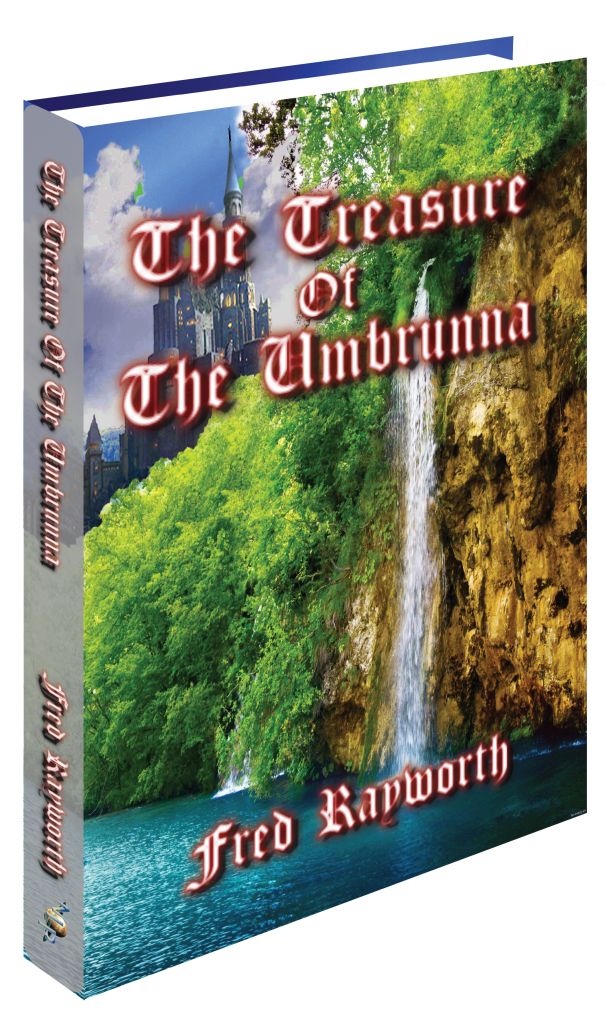
ISBN: 978-1-934051-86-3/Paperback
ISBN: 978-1-934051-91-7/E-Pub
 The Worlds Of Fred Rayworth