WHAT TO DO WITH THAT BURST OF INSPIRATION
For some of us, we can only work on one issue at a time. It’s called focus.
For others, we can multitask.
I’ve been known to work on a novel, which I’m doing right now. At the same time, I actively write these blog articles, work the Las Vegas Astronomical Society Observer’s Challenge, used to write weekly autobiographical articles for the now defunct Let’s Talk Nevada, and would still throw out the odd short story to submit to my writer’s group’s annual anthology. I’d even occasionally knock out the occasional short story, juss cuzz.
It all boils down to that burst of inspiration and a willingness to see it through.
NOTE IT OR DO IT?
A dilemma every writer finds themselves in is when they get the sudden burst of inspiration, and it doesn’t fit with what they’re currently working on, what to do? It’s a matter of either hitting the brakes on the current project or trying to preserve that inspiration so you can come back to it later. Or…work several simultaneously?
Will that inspiration still be there in a week, month, year?
Will you still want to revisit it at a later date?
Will it still have the same impact later?
For many of us, the answer may be no.
Now, ask yourself, can this new idea be used in your current project?
No?
Oh…kay. Now what?
Does it warrant a short story or does it require a longer form?
Once you make those determinations, maybe, just maybe you can either stop what you’re doing, take care of it, or maybe write it all down and come back to it after you finish your current project. Or, maybe come to a breaking point where you can stop what you’re doing long enough to scratch this itch.
SOME JUST CAN’T MULTITASK
I know, there are some of you that are going to lose out. You have to focus. You get a great inspiration, but it doesn’t fit your current project. You try writing it down and intend to come back to it. Several weeks, months, a year later, you find your note, but by now, you can’t grab that brass ring again. That idea that sounded so great is gone now. Those wonderful ideas you had racing through your head are gone, lost in the ether.
Oh well…
If you’d stopped your current project and followed your muse for this new thing, would that have messed up what you originally started on?
No sense worrying over something you have no control over.
For those of you that cannot multitask, the best I can tell you is write down these nuggets of inspiration and HOPE they come back. That’s all you can do. If they come back, fine. If they don’t, do NOT lose any sleep over it.
Other ideas will come along.
Time to move on.
EVERYONE’S DIFFERENT
No two people process things the same way. Even if writing is a passion, the creativity and inspiration comes to us in different ways. We have to learn how it works best for us as individuals. It makes no sense to beat ourselves up about how we get our ideas but to learn to work with them.
If focus on one idea is how you have to work, go for it. If you get that sudden idea, record it and hope you can get back the same feeling later when you can concentrate on it. If not, move on to something else.
If you can multitask, by all means, take a break from your current project and wail away.
Happy writing!
WHEN YOUR FAVORITE AUTHOR CHANGES STYLES
Something that’s happened too many times to me, mostly for the bad, is when a favorite author decides to shift their writing style.
Why?
They got bored.
Their publisher pressured them into it.
They decided to chase a trend.
Their muse took them that way.
Their fans demanded it (highly unlikely).
Sometimes this strategy worked for the author commercially…personally as well. Sometimes not.
THE BAD, THE UGLY AND THE INDIFFERENT
As usual, I won’t name names. There was once a great thriller writer. I devoured all of his books, written in solid third-person, past tense. In fact, the last great novel of his I read, I finished while we were camping at nearby Mt. Charleston here in Las Vegas. It was one of the last times we were able to camp up there before they closed the camp sites and converted them to day use only. That was around 2012 or 2013.
I anxiously awaited this author’s next book. When it finally came out around Christmas, for some reason, I opened it in the bookstore and leafed through it first. Maybe I was paranoid because of another book I got burned on, I’m not sure. In this case, I looked before I bought and it was a good thing. The author changed style and switched to first-person. For those that know me, you know I can’t stand to read first-person in fiction. I won’t go into the what’s or why’s in this article, but let’s just say I was so disappointed and pissed off, I actually did a one-star review on Amazon. This is the first and only time I’ve ever done a book review without ever reading the book. Why? Because the author wrote it in a style that’s virtually “unreadable” to me. I felt justified in my rating because I was expecting something else and the author disappointed me so much I couldn’t help myself. I clearly stated I never read the book, but also why I didn’t read it. That one-star rating was solely based on his writing style.
The author has continued to write in first-person and I haven’t read a single thing he’s done since. Oh well…
Case number two is another thriller writer I used to like. I read everything he wrote for years. Then he started collaborating with another author. Uh oh…
I got hold of their first effort, then leafed through the story. Crap!
As in total crap!
The story was written in third-person, but present-tense.
As you regular readers well know, I find present-tense unreadable in the extreme.
That ruined the author for me from that point on. Ever since, I’ve anxiously hoped for a change, but that author, even when he writes solo, continues to put out this crap in presnt-tense.
He used to write so well.
Now there’s another writer who back in the day, I had to struggle through some of his stories. I liked them but could never figure out why until I learned the writing craft. This guy used to write present-tense! I gave up on him because I couldn’t stand to read his stuff. However, I kept track of him, hoping he’d change.
Well, folks, he finally woke up. He started writing in third-person, past tense. His stories are so much better. They rock!
Now, I’ll mention a writer by name. Patricia Cornwell. This author is all over the place. She generally writes third-person, but has a penchant for present-tense. I was laid up in the hospital after surgery and had one of her present-tense books. Even with nothing else to do, I could barely get through that drivel!
Then MS Cornwell wrote the odd past-tense novel and it rocked!
To this day, I still check each book she puts out, hoping to see another one in past-tense.
THE LIST GOES ON
I’m sure you’ve had authors that for whatever reason, have stirred the pot, changed their formula. Maybe they didn’t change writing style, but genre. Now, for me, if they write the same, but change genre, I’m more likely to read it. If they keep the genre but change writing styles, that’s not the case. I have specifics about what I’ll read.
For those of you more tolerant, or for those of you that haven’t found your favorite, this all may be moot. For me, since I constantly read as well as write, it’s a key to my existence.
Since I write multiple genres, there’s one thing I can guarantee, regardless of genre, the writing will be the same. You can bet on that. If you like the way I write in one novel, and don’t mind switching genres, you’re more than likely to like my stories in another genre as well.
Happy writing!
LUSITANIA GOLD – THE WAITING GAME
At this point in the publishing process, I’m in-between things as far as this book goes. I don’t really have much to do. In the meantime what do I do? I work on other things like the sequel to Meleena’s Adventures which is Across The Endless Sea. I write my articles like this one, telling you what I’m up to or doling out advice on the world of writing. I may be writing a short story if the muse strikes. I may be working on the Observer’s Challenge, my visual astronomy monthly project. Just because the current book is in limbo doesn’t mean I stop writing.
Folks, I’m a writer. That’s what I do because as I’ve said many times in the past, this is a passion, not a hobby! I have self-imposed deadlines though nobody’s telling me I have to do anything. I do them “juss cuz.”
With all that in mind, where does Lusitania Gold sit right now?
PROOFING AND ARC
The last I talked to my publisher, the manuscript (MS) came back from the proofer with surprisingly few edits. Now that she has it, she’s completing the master and getting the ARC ready. What’s the ARC? The Advanced Reader Copy. However, what’s holding that up? The cover.
I got word also to seek out anyone I want for cover blurbs. There are two specific people I’m asking for endorsements. All I can do is ask. It’s up to my publisher to seek out others. The process is to send the ARC out to as many advanced reviewers as possible to create (hopefully) positive buzz for the upcoming book. This also gives some people a chance to look for last-minute mistakes.
THE COVER
There are some last minute tweaks to the cover which as of last Monday, were still being worked out. Maybe by this Monday (I’m writing this Sunday), I’ll have more news to tweak this article before I post it Tuesday. As of the last I heard, the cover is still on hold so the ARC cannot be completed. Oh…kay. Conversation with my publisher Monday morning and she’s seen the new version of the cover and it’s just about ready. I haven’t yet but should soon. Once that’s finalized, the ARC should be ready to send out.
PUBLICITY PACKET
I’ve turned in the mock interview and bullets. Now the publisher has to compress them, tweak them to fit precisely on one page with the headers and footers and then she needs a good photo of me.
AUTHOR PHOTO
I’m not sure if they’re going to use the same one from Treasure Of The Umbrunna or ask for a new one. I didn’t do any COSPLAY for Treasure so we’ll see. I have one from when I was researching Palmdale Gold, the third one in the Gold series, but it has me in a Mark Martin racing jacket, which is quite dated. No, I’m not a huge racing fan, but I liked the jacket and used to make fun of a certain commercial Mark Martin did when he still raced. It’s a long story. Anyway, that photo is on my Amazon author page and is me standing by the real lake that’s integral to the fake one I had to use in the story due to legal issues. It might be a more relevant photo than the author photo we used for Treasure Of The Umbrunna, but maybe not.
WEB PAGE ON FACEBOOK
Still nothing because I don’t have the final cover yet. I still have only the Detach And His Gold Adventures page on this web site which has no real updates yet, except those photos of the real Lusitania.
SUMMARY
At this point, it’s just a waiting game now. I’m sure there’ll be more things to do, so I have to be ready to go when I get the call or e-mail.
Folks, this is the world of publishing.
Get ready!
Happy writing!
LUSITANIA GOLD LAUNCH PRE PREP STUFF
For those of you that have never published a book before, there’s a lot involved in gearing up for a book launch. You’d think just writing the thing is enough, but noooo! There’s a lot more to it.
Right now, I’m in the process of finishing up all the last minute details for my second published novel, and the first in my adventure/thriller Gold series, Lusitania Gold. First a little history.
Though my first published novel was the fantasy Treasure Of The Umbrunna, when I started writing twenty-one years ago, it was with much different genres in mind. My first attempt, just to see if I could complete a novel, was science fiction. That novel, The Cave, will never see the light of day! Then I went into icky bug (horror). It turned out pretty good and will one day be published, I hope! Then came my adventure/thriller novel Lusitania Gold, originally put down into the ether in 1995. I’m now finally seeing it coming to print. It was well worth the wait. There are five others in the series that I hope will follow.
Whether you traditionally or self-publish, there’s a lot more to launching a book than just printing it. I’m past the editing process, so what’s next?
PROOFING
The manuscript has already been edited, but now it’s been basically formatted and printed in the rough book form. After that, it’s sent to the proof reader who goes over it with a fine-toothed comb (cliché, but so what?) and looks with a third, fourth, fifth set of eyes. The proofer looks for not only any last-minute editing details, but things like spacing, indents, page numbering, chapter headers, fonts, contraction consistency as well as a host of other things. Even though it’s been edited countless times, that last set of eyes catches as much as possible to make the book as high a level of quality as humanly possible.
Does this eliminate every mistake? Maybe not, but it catches the majority of them and after all, when you have something that’s almost 100K words or more, the more eyes the better.
PUBLICITY PACKETS
Depending on your marketing department, if you even have one, they should have some format for creating publicity packets to pass out to reviewers and book buyers. This may include an author interview and bullet points about the book.
I just finished the author interview and hope to have the bullet points about the story ready before this article hits this Tuesday (I did finish them and get them off after finishing the draft of this article).
Both of these items are intended to sell the book. They entice reviewers and book sellers to want to get a copy, or at least read a copy of your book.
THE INTERVIEW
This is a question and answer sheet (one page, to keep it simple and quick) that’s designed to tell a little about yourself and to pitch the book at the same time. It should convey who you are and what the book’s about. It should also tell what audience you’re trying to reach, why you wrote the book and what inspired you to write it. Maybe what research you did to get there and who or what were your influences.
THE BULLET POINTS
This is by far, the hardest to handle because you have to compress your entire novel into a single page of bullets, one to two sentences each with all the key plot points. You have to tell the entire story, including the conclusion. I’ve done three incomplete versions because I’m still getting bogged down into too much detail and have over a page and a half in each version and still haven’t got halfway through the book! The first try, I made a bullet for each chapter. However, with seventy-plus chapters, I’m going to end up with six pages of bullets! That’s not going to work.
Each time I get it down a bit more but I have to sit back and summarize huge chunks into simple single sentences. Just the facts, ma’am.
THE COVER
If you self-publish you should have complete control over the cover. At least I assume so and have seen that many times. That means either paying an artist or trying to do it yourself. A poor cover can kill your book before it gets out the gate.
Since I’m traditionally published, I have only limited control over my cover. However, I’m able to give some feedback now, at least to tweak the design. I’ve seen the cover and am giving feedback. This is all part of the process. At the big houses, from what I understand, the authors have no say at all on the artwork. As soon as I have a final design, I can set up my Facebook page.
WEB SITES
Right now, I have a page on this web site for Detach And His Gold Adventures. It has some real photos of the Lusitania, but no book cover yet. That page is for the entire series, not just Lusitania Gold. That goes for Meleena and here adventures as well on the Meleena page.
SUMMARY
There’s still much to do, but this gives you an idea of what else’s involved in getting a book to print. I haven’t even delved into the business cards, bookmarks, publicity sheets and videos. Then there’s the marketing, submissions themselves and all the fun stuff that goes with it.
Happy writing!
COFERENCE AFTERMATH – GREAT TIMES
It’s with a touch of sadness and a bit of relief that the 2017 Las Vegas Writer’s Conference came to an end on Saturday night, April 22, 2017. I look back on those three wonderful days and it’s hard to sum up all the happy and fulfilling feelings, as I do every year from this big event. I would hope others that attended came away with at least some of those same feelings.
With this being my twelfth writer’s conference, it might seem like old hat by now. I never fail to have a great time.
EXCITEMENT OF THE SETUP
As usual, I arrived way early, though because of short staffing at Starbucks, I arrived only about five minutes to 8 and there were already other people in the rooms. Gregory Kompes, our current and outgoing club el-presidente as well as Paul Atredies, the conference coordinator were there. I started setting up the registration table, the room easels and I put on the room signs. In the meantime, more volunteers showed up and got all the swag and the booklets and bags and set up the room where we started an assembly line to stuff the attendee bags. After I did my other stuff, I helped with the bag assembly line.
During all that, Linda Webber, Toni Pacini and Amana Skenandore showed up to set up the silent auction and raffle items for display in the main room.
By 10 AM, we pretty much had everything ready to go.
Though there were minor glitches, to be expected, especially for a sold out conference, things went well over the next three days.
MEETING AND CIRCULATING
One of the big points of attending a conference is to meet people and circulate. This is no place to be a wallflower. One advantage to working the registration desk and handing out badges is that we get to meet everyone and I certainly did! This not only includes the attendees but the faculty. Of course it’s not in-depth, but at least we can put a name to a face, though with my short-term memory, it took a bit more reinforcement later for that to sink in.
As soon as the initial flood of registration took place on Thursday and the first classroom sessions started, I was able to break from the desk a bit. I took a class for on-line marketing and it was well worth it. On Friday, I took one on beyond Google internet searching. It was geared mainly toward non-fiction, but it’s something applicable to fiction as well. I certainly used it already in Lusitania Gold. On Saturday, I sat in on a bit of a course on symbolism but it wasn’t really for me and then one on multi-faceted characters. I made it almost halfway through that one.
NOT EVERYONE WAS THERE TO GET AN AGENT
Between classes, I talked with attendees and a few staff, off and on, and got to know some of the people, what they wanted out of the conference, why they were there. I was glad to hear that not everyone attended just to pitch to agents. A good number of people came to learn about the craft of writing. Some didn’t have a completed manuscript and wanted more direction. This is something I’ve talked about over and over again and I see people have done just that.
SOME WANTED TO PITCH BUT…
I was one that had no interest in pitching. Though I still have not submitted my icky bug novels to my publisher, I’m not actively pursuing their publication at this time. I’m concentrating on my fantasy and adventure-thrillers at the moment.
We had several people come up to the registration table and relay their fears and frustrations about pitching. My partners in crime at the table, Donald Riggio and Ray Katz and I talked with them about different aspects of the subject. We convinced one girl, in particular, to shift from her young adult to her fantasy novel, which she should’ve pitched in the first place. She ended up getting asked for the first fifty pages (or something like that). At first she wasn’t even going to pitch it and we talked her into it, so that was one success story.
At one of the meals, I forget which one, I sat at my usual table. I do this every year and usually get a different crowd each meal. I talked to one lady that wasn’t sure if she was going to pitch and I talked her into trying for practice. I never did find out if she was successful.

DONALD MAASS
Our keynote speaker was super literary agent, Donald Maass. He’s known for his book, Writing The Breakout Novel. He was our keynote speaker and also was conducting a special seminar on Sunday, the day after the conference (which I didn’t attend). When he arrived on Friday, we chatted a bit and both me and Donald Riggio told him how he’d rejected us. He rejected me three times but I soldiered on and have been writing 21 years and piled up 689 rejections bla bla bla.
During Donald’s keynote speech, Saturday night, his subject was hope. In it, he indirectly mentioned me and my 689 rejections. He got the number wrong, but the intention was there!
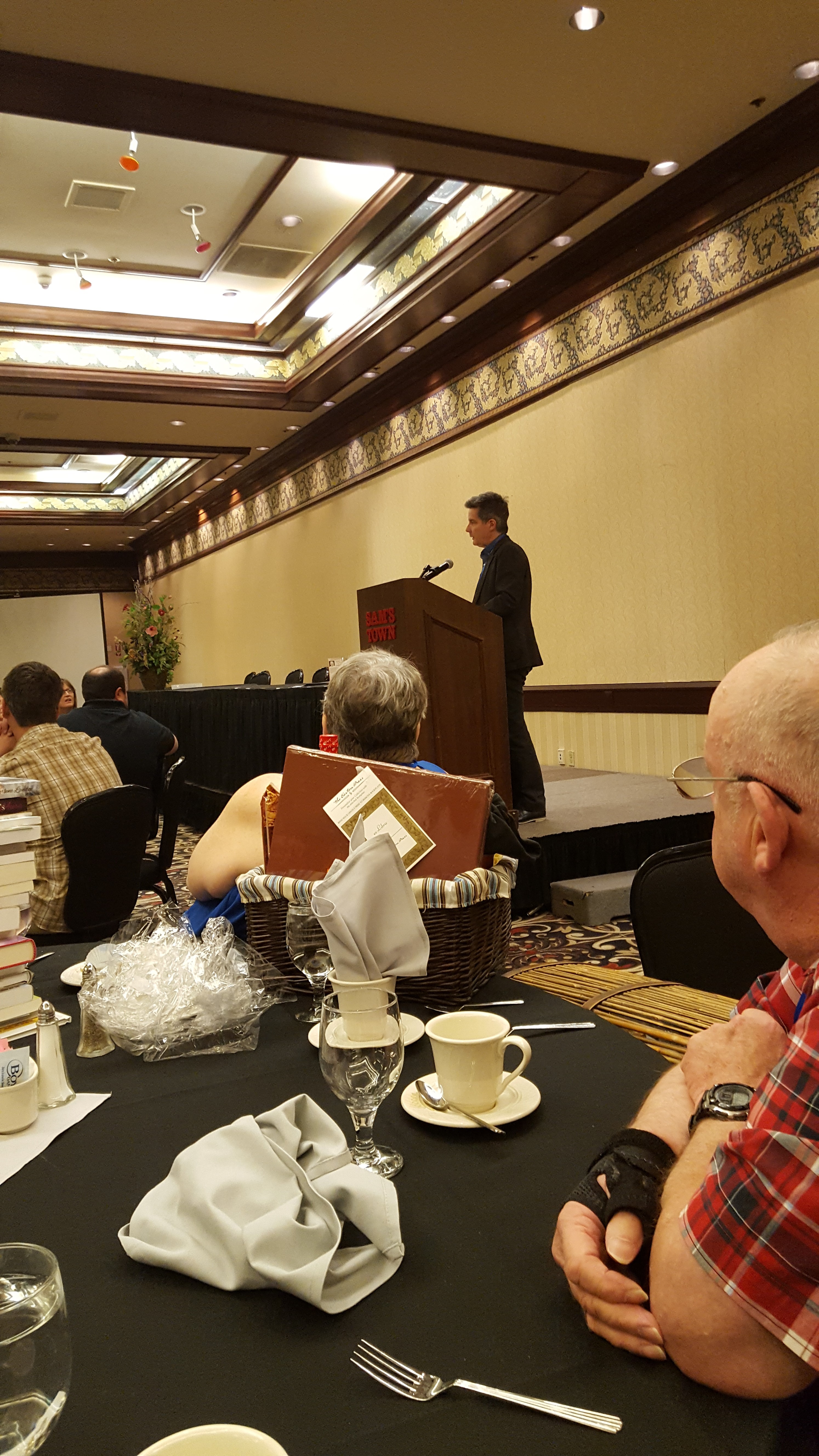
After the conference, I got in line to shake his hand and thank him for mentioning me during his keynote. However, he kept bypassing me and talking to other people. By that time I just wanted to get home so I walked away. I was tired, wanted to get home and had had enough.
Never did get to shake his hand, but oh well…
One other good thing. I’d brought a stack of Treasure Of The Umbrunna to the conference bookstore. I sold one, to who, I have no idea. I would’ve been glad to sign it.

Happy writing!
ICKY BUG – THE STORY BEHIND THE PHRASE
I’ve talked about this numerous times through the life of The Worlds Of Fred Rayworth. This will be the first time I’ve ever consolidated the entire story into one place at one time, solo, so to speak.
If nothing else, it’ll be easier to locate on the net.
I bring this up because I often get curious looks, have to explain, in at least a short phrase, once in a while the long but still edited version, of what the hell I’m talking about. Just the other day, I got a reply to an Amazon book review and the responder had only one question, “what in the world is icky bug?”
I gave a brief response.
THE WHOLE STORY
It was a dark and stormy night…
No, actually, it was a bright and hazy, humid afternoon midway, between Adana and Incirlik (pronounced “Injure-lick”), Turkey in 1980. The four of us were temporarily housed in a roadside place called Mocamp. It consisted of single to two-bedroom units, sort of like a motel but spread out into individual duplexes with a central restaurant. Set in a large compound with tended lawns and rose gardens, it wasn’t all that bad of a place for being in well…Turkey.
All along the road, going both ways were farm fields and Gypsies with mules and horses piled high with branches full of firewood, the occasional camel caravan, cars, trucks galore, and other various buildings as well as power and phone lines. A little further down the road was a Russian built cement plant, spewing a constant haze of line dust and just past that, Yılankale, or as it is known locally, “Snake Castle.” This is a close-up shot of the back or south side of the castle.

We stayed there because a few weeks before, early April, we arrived during the worst flood they’d had in the country for the past twenty or thirty years. The nearby Ceyhan River flooded (pronounced “Jay-han”), and the base power plant was underwater. The base only had temporary power. The on-base billeting we stayed in had no power and no water. We used trash cans outside under the rain gutters so we could catch enough water to flush the toilets.
This lasted for about a week and a half until a bowling team came in from Germany, from Rhein-Main Air Base, or someplace. They kicked us out because they needed the space. It turned out to be a good thing. Mocamp not only had power, but water as well!
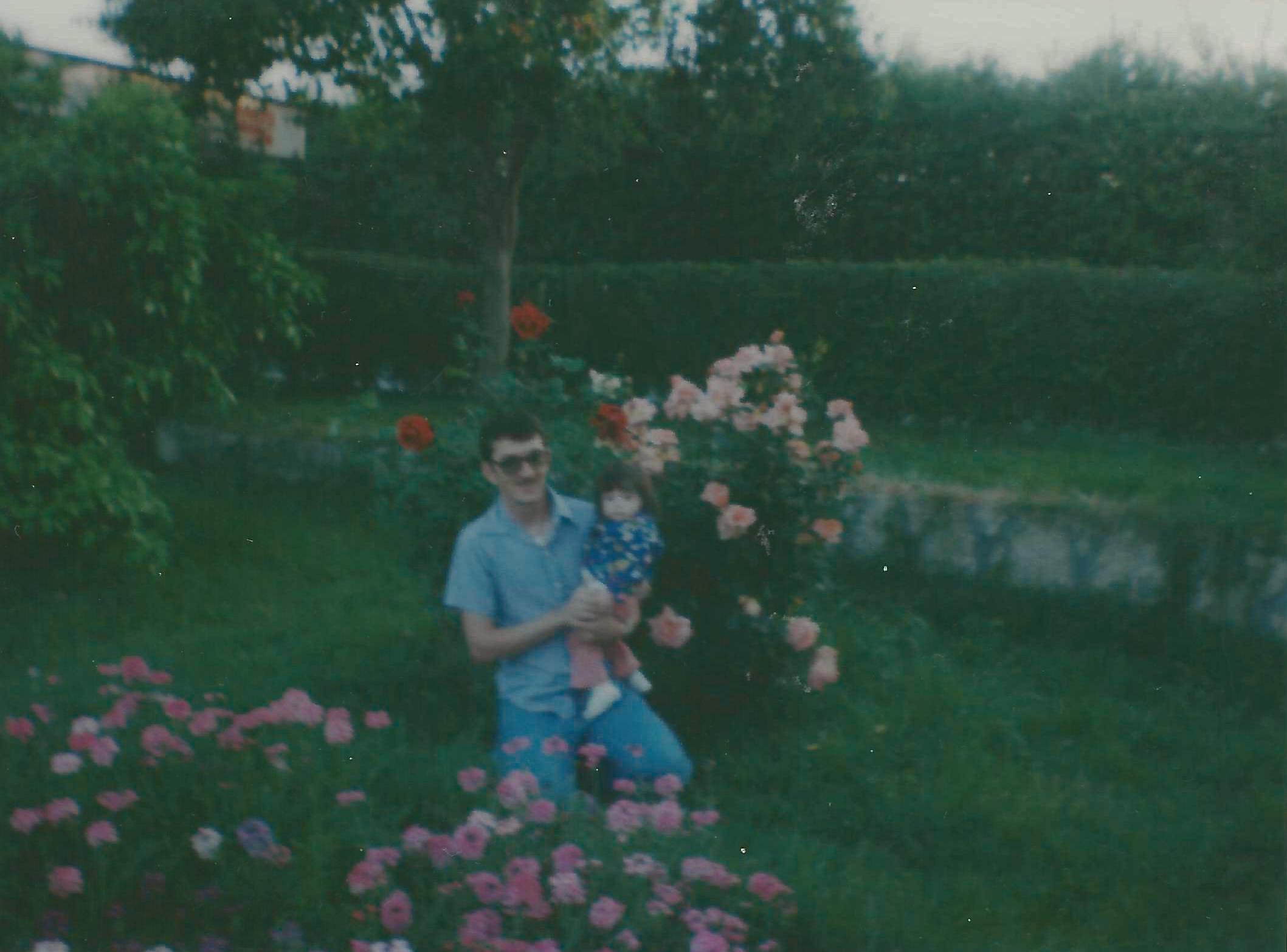
We settled into the room, several days into our stay. My wife and I were watching a monster movie on TV, a tape we rented from the base video store. I forget which one, but it was a b-monster movie of some kind. Outside the screen door, within view, the babies, one four, the other one and a half, were playing in the grass by the rose garden next to the sidewalk.
This is me with the one year old.
Our oldest was prone to hysterics. Keeping the babies in the corner of our eye, all of a sudden, we heard this ear-piercing scream, like someone was killing the kids.
We…I say we because we were both sitting there and could see both kids in full view…got up to go see what all the fuss was about.
When we approached the babies, the older one was still screaming and pointing at little one.
“What’s wrong? What happened?”
“Eeeeee! Icky bug!”
“What?”
I looked over and the baby had an earthworm in her mouth.
I took it away from her, wiped off her hands and my wife gave her a sippy cup or something and we went back inside.
I thought of what older daughter said, saw the monster on the screen and folks…
There you have it.
Icky bug.
SUMMARY
I didn’t take up writing for another decade, but every time we watched a monster movie, I thought of Mocamp and what older daughter said. When we went to the video store, or one came on TV (when we got back to the states), I usually called them “icky bug” and it just stuck.
When I wrote my second novel, called The Greenhouse, guess what I called it. Instead of horror, I called it icky bug.
Though I’ve had to ‘splain myself’ since, I never looked back.
Just one of those things.
So, a long story…long…with visual aids…even a creepy castle included!
Happy writing!
PITCHING SUMMARY 2017
INTRO
Every year, I do at least one article about pitching prior to the Las Vegas Writer’s conference. Since each one is basically a repeat of the previous year, what I decided to do this time was take last year’s three articles and condense them into one long article. This saves you going back into the archives. Those of you looking for insight from someone who’s had 100% effectiveness getting a foot in the door, regardless of the final outcome, you might find this info useful.
Also take note that what I present below doesn’t necessarily comply with the latest standard teachings of my writer’s group. Therefore, at the meetings, I stay silent. However, it works. Trust me on this, and no, that’s not a cliché. It’s the truth. It really works. Take that for what you will.
THE PITCH LETTER (QUERY LETTER)
Probably one of the hardest things an author has to write is the pitch letter. I’m reminded of the teen who doesn’t want to finish high school and comes up with the excuse, “Well Axl Rose of Guns N Roses never graduated, and look at him. He’s a big rock star millionaire.” Well, there’s ambition and dumb luck. He could just as easily have failed and never would’ve had anything to back himself up with. Mr. William Bruce Rose Jr. (his real name) might be the guy cleaning your pool while you’re making the big bucks because you went on to get a degree. Why I bring this up is that some authors think their story is so hot they won’t need to sell it. Agents will be knocking their door down to buy it from them. A pitch letter, or trying to pitch their story isn’t on their radar. They can skip the hard work because their story is so hot, luck (agents and publishers) will seek them out. In other words, lightning in a bottle.
THE REAL WORLD
Unfortunately, that doesn’t often happen in the real world. The funny thing is that I actually did see it happen once at the very first writer’s conference I attended in 2005. There was this teenage kid pitching a story he hadn’t even completed. He didn’t have a proper query letter or even any writing samples, as I recall. Yet when he pitched his idea to one of the young adult agents, she signed him on the spot. To this day, I don’t know if anything ever came of that kid or his book (if he ever completed it), but it was one of those magic Axl Rose type moments where lightning strikes. I was there to witness it.
Do you think it’ll happen to you? Fat chance! You, my friend, are going to have to work for it like the rest of us, if the numbers bear out. So, suck it up and start reading.
NUTS AND BOLTS
The pitch letter, or as it’s more widely known, the query letter, is your way of getting the attention of an agent or publisher. It’s a way of tapping them on the shoulder and saying “Hey, I’ve got something to show you.”
Agents and publishers get literally hundreds, if not thousands of these letters per day/week/month. They’re always looking for the next best thing, something they can sell and from which they can make a ton of money. At the same time, they have to slog through all this crap. To get their attention, you need to be brief, to the point, no bull. Or as Jack Webb used to say in Dragnet, “Just the facts, Ma’am.”
TO THE POINT – FAST
It’s critical you keep to the point and be concise in a query letter. You’ve got just a few quick lines to blow their socks off, to pique their interest, to leave them wanting for more. By the time that agent or publisher reaches the end of that letter, they should know the story is a good fit for their agency, they should see that you have the chops to pull it off, and are intrigued by the premise, or pitch line. If you can do those three things, I can almost guarantee they’ll be asking for more.
FICTION VERSUS NON-FICTION
I need to tell you up front that this discussion is tailored to pitching fiction and not non-fiction. When it comes to queries, they’re two different animals. I’ve never pitched non-fiction and don’t have a clue how to do it, so if that’s what you’re after, sorry! They’re (non-fiction queries) called proposals, by the way. However, the basic principles still apply. The only difference is in the format and content of the actual query letter. Everything else I’m telling you is the same.
WHAT NEXT?
Now that you’ve heard the inevitable (you’re going to have to do one), how are you going to go about it? The easy answer is to tell you to go to the bookstore or the wyberry (library) and stock up with literally (if that isn’t a metaphor) hundreds of books on writing query letters. Or, I could condense it all down for you and let you know what’s worked for me and what hasn’t (based on the mistakes I’ve seen other people make). Keep in mind that you can come up with a generic letter, but trust me, you’ll have to modify it for each agent. Not only is it good to personalize each one, but many agents have their own ideas of what a query letter should contain. A generic query letter smacks of impersonalization. That, my friends, is a big red flag with a trash can bulls-eye right in the middle of it.
THREE THINGS
The most successful query/pitch letters contain three things: The slug line (or pitch), what the story is about, and a bit about yourself (what makes you qualified to write the story). Of course, you don’t write those things exactly. Remember, this is a letter to a person, not a machine. The key is that the letter should be brief, to the point and only contain relevant information. On top of that, it must be grammatically correct, contain no typos and something you might not always hear from others, it cannot contain any negatives or sarcasm.
Whatever you do, do not put yourself or others down! Do not use sarcasm! I must step back and say that if the sarcasm is part of the plot or storyline, that’s something else. If it’s about you or other authors, don’t use it!
DON’T GET CUTESY-POO
Another thing never to do, well, something that is extremely risky and 99% of the time doesn’t work, is to write the query letter in character. For example, I’m talking about your main character being a hard-bitten detective with a few screws loose upstairs. He or she writes the letter. It’s written on an old typewriter with a cigarette burn in one corner and coffee stains in another. The letter is folded wrong and you sign it with your character’s sloppy signature, typing your real name and address on the envelope. It’s cutesy-poo to-the-max, but most agents and publishers have been there and done that and can’t hit the trash can with it fast enough. Some may even respond with a nasty letter.
Or, a romance writer may send their query on frilly stationary soaked in perfume.
Play it straight. No gags, no gimmicks to get yourself noticed. I’ve had more agents tell me they get extremely annoyed by these tactics and put these authors on their ***t lists. Though you’ll hear the anecdotes where this method worked, once done, it’s cliché. Keep that in mind.
REPEAT
I repeat, it’s extremely important the letter have no typos or grammatical errors. When an agent gets hold of it, if they see you can’t even write out a single page without an error, what will a novel or short story look like?
What Not To Do in a query letter
In this first part, we’ll get down to some technical thingies. We’re going to go over what not to do. Then, I’ll show you one that’s worked.
NEGATIVITY
I mentioned never to use negativity, or put yourself down. Here are a few examples. Some are overt, while a few may be a bit more subtle.
I know you get lots of submissions, but before you throw mine in the slush pile, I’d appreciate if you’d give me a chance.
Ding ding ding! Red flag! You’re starting negative right out of the gate! Don’t even bring the subject up! In the first place, you should be starting with your slug line. Second, you’re giving the agent the perfect excuse to do just what you are hoping they won’t do.
I’ve been submitting to lots of agents, but was hoping you’d be the right one for my work.
Do I have to explain this one?
I’m a struggling writer and found your agency on line. I would like to present my character…
A little more subtle, but saying you are a struggling writer is not only a cliché, it’s a given and also a negative. No need to voice it. Scratch the first sentence.
Thank you for considering my work. I may not be the best writer in the world, but I know I’ve come up with a winner here.
You had him or her at the first sentence and blew it with the rest. Hack off that second sentence.
IRRELEVANT MATERIAL & FLUFF
Now for a little biography sample.
I’m an accomplished writer with high grades in English grammar in high school and college. I excelled at all of my term papers and almost had an article published in the alumni newsletter but due to budget constraints, the issue was never printed. I had a short story called The Flag printed in Mystery Journal for Fiberglas Press, 1989.
She’s a mystery writer. The only relevant credit is the last one. The rest of it is pure fluff and irrelevant. Trash it. Inflating a bio with irrelevant material is no way to win friends with an agent. If you only have one credit, so be it. In the good old days, it was okay to throw in the kitchen sink. Nowadays, agents don’t have time to slog through all this crap looking for gems. You’re better off to keep it tight and right. Besides, almosts don’t count.
BRAGGING, SARCASM
I’m sure you get lots of “great” stories at your agency, but now get ready for a real treat. XXX will blow you away.
Oh, please! Sarcasm, conceit, bragging, grammar problems, the list goes on.
One That Worked
Now I’m going to show you a pitch letter that worked. Below is the letter that I handed to the publisher that gave me the contract for my upcoming novel, Meleena’s Adventures – Treasure Of The Umbrunna. Keep in mind that I handed it to her at the Las Vegas Writer’s Conference and pitched to her in person. After I sold her on the idea, she had me send it along with the first 50 pages plus a synopsis, which was on the back of this letter.
I’ve included notes of explanation where appropriate, and left off the headers and dates and a photo, which is something (the photo) you shouldn’t put on a letter you’re mailing out (though this is something up for argument with some authors and agents)! Also, I modified parts of it (left off the second paragraph) so as not to give away the actual plot in case anyone wants to read the book, which is out now.
Re: Meleena’s Adventures – Treasure Of The Umbrunna
Fantasy – 79,500 words
Pen name: Ray Brooks (I have since dumped this idea and went with my real name).
All she wanted was to get rich, but in the end, will she sacrifice all to help another? If she isn’t careful, people may start to think she’s a decent person. (This is the pitch line, the first thing I said to her after introducing myself.)
Meleena goes through life one picked pocket at a time. With a wild heart, she spends each night with a different man, and often wakes up in a strange place. When she goes after a valuable pearl hidden in a lost city called Slab, she figures this is the way to the easy life. An old magick user named Grel may hold the key to finding this pearl, and he insists she not go alone if she hopes to survive. Despite second thoughts and an aversion to working with others, she gathers a team and heads for the lost city. However, she’s not the only one after the pearl, and Meleena enters into a race to get there first. (This is the body of the text. It should be one paragraph, but I broke a rule and made it two short ones (the second one I left off here). It worked. They were condensed from the original. The whole point was that the entire letter had to fit on one page, letterhead, spacing, signature, credits, all of it. Keep it brief!)
I’m a member of the Henderson Writer’s Group in Henderson, Nevada. My short story, The House, appeared in the anthology Between the Pages, 2003. The Walk Home was published in the story collection Writer’s Bloc 2006, The Basement in Writer’s Bloc 2, 2008, and Fun In The Outland in First Voyage, 2008. (Remember, relevant writing credits, which should include a writer’s group, if you’re in one. Though none of these stories are actually fantasy, the chances of the publisher checking, or actually finding those books were pretty slim, so I took the chance. Turns out, many of those books were for sale at the conference! Also, the titles could mean anything, and at least they show I’m a prolific and published writer. Just make sure if you do this, you don’t put something down that’s obviously not relevant. Also, note that the info is dated. I’ve since published quite a few more things that aren’t listed since this was written several years ago, plus one short story directly related to Meleena.)
Thank you for your time.
Sincerely,
Fred B. Rayworth
There you go. An example, a visual aid, without giving away too much of the actual story, but hopefully, enticing you to read it. This example also gives you an idea of one way to successfully pitch to an agent.
THE SYNOPSIS
The synopsis is a breakdown of your story. It’s another form of an outline, but in complete sentences, no bullets and in present-tense. The purpose of the synopsis is to tell your complete story to the agent or publisher. Specifically, you need to outline the main character, the main conflict, and the resolution. Yes, you must tell the ending. The synopsis tells the complete story (I repeat), from beginning to end, in abbreviated form. The key is the length. For the pitch letter at a conference, and for some queries to agents, it should be one page. For some agent queries, it might be two to three pages. From there, where a full manuscript is requested, it could be three to ten pages, depending on the individual requirements of the agency. The key is to follow their instructions explicitly. As a general rule, stick to one page, unless told otherwise. One good thing about sticking to these rigid requirements is that it keeps your writing tight.
THE SYNOPSIS WILL SHOW FLAWS IN YOUR PLOTTING
A synopsis can be extremely hard to write properly. However, it can also be a very good way to reveal how well your story has been put together. It’s a good way to spot any red flags in flow and plot. When you break down your story into a few paragraphs, just to get the key plot elements, you’re going to see right away if it all holds together. If, at the end of your synopsis, you notice that the story doesn’t hold water, you may need to go back and do some rewriting!
BULLETS
One way to develop your synopsis is to start by describing each scene or chapter (if you have a lot) in one bullet sentence. Compile all of these bullets and look them over for the key patterns. If something looks extraneous, maybe it shouldn’t be there. Once you have that down, turn these bullets into sentences and then organized paragraphs so they flow together.
For me, I have the whole story in my head. In my creative process, I only know where I want to start and where I want to end, the middle is a total surprise. Once I get going and write it all down, it becomes locked in my head. As I edit it over and over again, the plot and all the details become locked in so when I sit down to write my synopsis, I already have the big picture going for me. I don’t have to bullet out each chapter. However, I don’t expect all of you out there to write or create the same way I do, so I’m throwing that bullet method out for you.
KEEP CHARACTER NAMES TO A MINIMUM
The key elements are that you introduce the main character and maybe their adversary by name only. Everyone else remains unnamed. They’re just anonymous characters as far as the synopsis is concerned. The first time you name these one or two characters, you put them in italics. From then on, they’re in regular font. Don’t get bogged down in unnecessary details such as naming a whole bunch of characters, names or places in the story. Don’t list time lines either, especially on a one-page synopsis! Describe the plot, describe what happens, describe what, where, when, why and how the character gets from point a to point b and what happens at the end. Nothing more, nothing less.
If you’re writing a two, three or more page synopsis, a few sentences per chapter might be appropriate unless you have eighty chapters. Again, if you do this, it should read almost like a short story. It should make sense on its own. If it doesn’t, you need to work on the plot some more before you try pitching it.
DON’T LET IT GO, SIGHT UNSEEN!
The final element to all of this, before you ever even think of turning it in to an agent or publisher: Get someone or several other people to read it first! There’s nothing like second sets of eyes to see what you can’t!
THE FACE TO FACE
LIKE A JOB INTERVIEW
I’ve always considered the pitch session as a job interview. That’s exactly what it is. The difference is that it’s a two way street. Not only will you be working for the agent and/or publisher, they’ll be working for you. When you get right down to it, you’re also interviewing them. The biggie right now though, is that the person you’re about to sit down with is holding all the cards. They have the power, the knowledge, and the abilities to take your hopes and dreams and turn them into a reality.
To make this less dramatic, you have a product and you’re looking for a manufacturer to produce, distribute and sell that product. You’re the inventor of said product. It’s your job to try to convince a manufacturer to take your product, refine it and produce it for mass consumption.
If you’re lucky enough to attend a good conference, you might have a scenario similar to what we have at the Las Vegas Writer’s Conference. I’m using this one as an example not only to once again plug it (it takes place 20-22 April, 2017), but also because I have intimate knowledge of how this conference works.
MILLING ABOUT
You’ll sign in, and for the price of admission, get to pick at least one agent appointment slot, maybe more, depending on the schedule and the number of people adding in names. From personal experience, I’ve never had a problem seeing any agent I’ve wanted to see. These appointments might be the first, second, or third day, first thing in the morning through the end of each day. Because of that, there’s a good chance that during any classes (seminars) you choose, during breaks, and during meals you might find yourself talking face-to-face with the very agent to which you’re going to be pitching your book. These are good times to get to know them, feel them out, find out what are their likes and dislikes. Get to know them as a person. You’re more than likely going to find them great people. Once in a while, you’ll find a total jerk. That’s happened to me a few times. I pitched to them anyway. Most of the jerks actually had me send them something and I got the expected results. One took two years to respond. I’d totally forgot about him, then out of the blue, I got a letter. “Not for me.”
As I alluded to above, the agent you’re pitching to might be teaching one of the classes (seminars) you signed up for. That’s another good way to get to know them and what they stand for, what they like and dislike, and how you might approach them. Meals are a good place to talk shop and hear the latest gossip in the publishing world. You can learn the trends and even find out what’s going on with your genre. That could help you slant your pitch when you sit down with them.
THE SIT DOWN
When it’s finally time for your pitch session, even though you may have met face-to-face before, sit down, shake their hand and introduce yourself. Then, when they ask you to tell them about your book, start out with your slug line. Those are the one or two sentences that introduce your story. From there, if you wrote them well, the agent should ask you to tell them more. That’s when you give them a brief, and I mean brief, synopsis including how the story ends.
Do not, and I mean do not ramble on and get off on tangents! Watch the agents’ body language. If their eyes start to wander or glaze over, you’ve lost them. You have to give them a one-two punch. You have to make them want more. When you sit down, your pitch letter, with the short synopsis on the back, should be slipped over to them first thing. They may glance at it, they may not. They may actually read it as they listen to your pitch. However, the chances are, they won’t actually take it. They’ll have you mail it to them. If that’s the case, make sure you revise the letter at the first paragraph to include that it was really nice to meet and talk with them at the Las Vegas Writer’s Conference bla bla bla (or whichever conference you attend). That paragraph is key, so that it puts a time and place on your meeting. Also at the bottom of the letter, make sure to include “I’ve attached … sample chapters and a … page synopsis per your request.”
Lately, agents and publishers have been asking what you’ll do to market your book. I’ve watched as some authors look back with blank faces, or stumble around, hem and ha and go blank. How you’ll market your book is now the hot-button topic to add to your list.
Be prepared!
One more thing, never ever force pitch your book in casual conversation. Don’t be pushy. That’s a great way to turn them off. However, if you’re talking at lunch, dinner or wherever, the subject of your writing comes up and the agent says, “Well, tell me about your book,” they’re inviting you in. Otherwise, leave the pitching for your appointment.
From here forward, all I can say is good luck, and happy writing!
AMAZON SLOWLY SHUNNING OUTSIDE REVIEWERS?
As many of you know, Amazon, the “king of all media,” ahem, “retailers of all media,” I should say (thank you Howard Stern), sells just about everything. They started out with just media, but branched out to many other products, too vast a variety to go into here.
I found their selection of books, CDs & Vinyl, computer games and such the most definitive source to place reviews. If I had something, no matter how obscure, and wanted to review it, I could almost guarantee Amazon would have a place for it.
There were many of said items out there, listed on their site where I was the only reviewer. Period.
Some of my reviews actually prompted people to contact me, including former band members, fans, adversaries, you name it.
In one case, a not so obscure telescope eyepiece I reviewed cause the formation of a thread about me on an astronomy forum. I wasn’t even aware of the ruckus until someone else commented to me through Amazon and told me what was going on. Once I joined the forum and put in my two cents, that was when the fun began. Nasty comments and hate mail ensued.
I found my reviews, at least in my mind, helpful, honest and from the heart.
Nowadays, I cringe at some of them because I started so long ago, my writing chops weren’t as clean as they are now. Plus, my opinions have changed on a few of those early items. Some a bit, some a lot. In one case, one of my bad movie reviews was deliberately taken out of context and used in a positive quote!
THE GOOD OLD DAYS
Whether people bought (or force bought through no other choice) their items from Amazon, it was simple and easy to see all the reviews on an item with one basic click. If there were many, you could just scroll through them from page to page, or sort them by the star rating. You could even sort by the latest posted. On the more obscure items, there were usually not that many reviews, so it was pretty easy to find them.
I, for one, did honest reviews and never ever discouraged anyone from buying the item from Amazon. Sometimes, I actually encouraged it because it was the only place it was available.
I was easily able to tell how many reviews I’d done. I could click on my name and tell right away if I’d done 60, 600 or 1,000 reviews.
It was a bit tedious to search them all for a specific one, especially if it was buried in a popular item with several hundred to several thousand reviews, even considering the number ratings of say, if all the three or five star ratings had four hundred to six hundred reviews each. If I went to my personal page and looked for it (used to be, just click on my name), my only choice was to scroll through them, or go to my computer hard drive and find it there. Then again, sometimes, what was on my hard drive didn’t always match the final version on Amazon. Not only did I sometimes tweak it before I saved on line, in the old days, I sometimes reviewed right on line and never saved it to the computer. Or, I lost some reviews due to computer crashes and incomplete backups, etc.
AMAZON AND GRADUAL TO ABRUPT CHANGES
Slowly, it became harder and harder to find my reviews on the personal page. The first thing I noticed was that I could not find my review count. Why would I care? No big reason, juss cuz. However, I wanted to make sure I had everything matching what was on my hard drive. I did not want to miss anything. Since I’d gone through several computers since I first started reviewing several decades ago (as explained above), I wanted to make sure everything was up-to-date. In that process, I was trying to find the easiest way to get from A to B. That led to this discovery.
I just checked this morning, as I edited this. My reviews are still there and the count is at the top, where it should be in the personal reviews tab. As of that moment, I had 1147, though that number will change by the time you read this. However, there are only two search parameters. Most recent reviews and Most recent comments. There are no other search parameters so scrolling through page after page, looking for a particular review, I’d better have them on the hard drive!
Next, Amazon made the more recent and more radical change.
AMAZON PURCHASERS GET TOP BILLING
Yup, that’s right. Amazon, in all their wisdom and greed, even though they’re the obvious top dogs in on-line retail, took it upon themselves to take all verified purchase reviews and put them up front on all items. Okay, I can sort of understand that. However, a review is a review. They help sell products, whether good or bad. They help people make decisions.
They have their reasons for doing so. There was a lot of abuse, which I totally understand. I could go on and on about that. Also, maybe the other retailers do the same, but my suspicion is that most people, whether they buy from Amazon or not, go there first to check the reviews before they go anywhere else. I know I do. With all the tools at their disposal to cut down on bogus reviews and abuse, this extra step seems a little over the top.
Now what about those other reviews? Like most of mine?
Okay, I do buy from Amazon, occasionally. However, I prefer to buy retail if I can. I like to touch and feel and sometimes smell the item before I buy, and you just can’t do that online. Most retailers I buy from don’t have web sites, or at least ones where I can do reviews. If they do, I don’t want to have logins to hundreds of different web sites with different quirks and standards. I’m used to Amazon and it always used to work!
In a way, I consider Amazon sort of like the Wikipedia of reviews. Is that bad?
Also, what about items I already have? There’s older stuff I’ve had that I revisit and want to review. Stuff that maybe I want to put out there that’s still worthy (or not) for people to seek out. Surprisingly, a lot of it is still available on Amazon.
So, what happened to all of us “others” reviews? Oh, they’re still there. However, you have to jump through hoops to find them.
You go to a book, for instance. There are 25 reviews. However, when you look at the list, you only see 10. Why? It automatically defaults to Amazon purchasers only. All the other reviews are hidden.
Whaaa???
If you want to see the rest of them, you have to click on the little in blue “…customer reviews” The ellipses being a number like 25 or 76 or 1,000.
Then you once again have to go just above the first review and click on “See all verified purchase reviews” in blue which is just below the star rating bars.
Then it takes you to the search parameter selection blocks.
Now, a nasty little bug I’ve found when I sometimes click on “All reviews.”
I click “All reviews” and the list populates. However, I want to see them in order of most recent. So, I click to sort them again. Guess what? It goes back to the default of Amazon Purchasers only! Or, at least it did sometimes. Lately, it seems to work properly. In my most recent example, not long ago, I did a review of Steppenwolf’s first album. When I hit All Reviews, then hit Most Recent, my review was at the top and below that was nothing but Verified Amazon Purchases. Go figure.
Those geniuses at Amazon trick out the system so it becomes very convoluted to see all reviews. I’ve found the same thing happened when I wanted to see all three star reviews, or one star reviews. It ALWAYS goes to Amazon Purchasers first. Then you have to say “All reviews” and it goes to the whole list. If you click on one star, it may or may not give you all or just Amazon Verified, or it used to.
I’ve found it hit or miss until recently where the filtering seems to be a bit better.
The other thing is limiting non Amazon Verified to five per week. I don’t have so much a problem with that. It’s the other issue that has pissed me off until recently.
WHAT NEXT?
So, what next? Banning non-verified Amazon reviewers altogether?
SUMMARY
I DO like Amazon, mostly. I’ll continue to buy from them and use them. They are the best out there for on line. However, with them being the big boys on the block, it seems to me they’re getting to be more of a bully about things. I know a business is a business. I can’t knock that they have the most comprehensive stock I’ve ever seen. However, I think sometimes they go over the line.
There’s also the possibility of Amazon brick and mortar stores in the future. If so, will they have the same comprehensive stock available in stores that they have on line? Only time will tell.
What do you think? Am I over the line? I mean, it’s not like I can do a thing about it. I’m still going to review and still use Amazon. There are many things about them I DO like.
Happy writing!
 The Worlds Of Fred Rayworth